by Jeffery W. McKelroy
The city of Janesville, Wisconsin sits on what was originally the home of many different Native American tribes, primarily the Ho-Chunk and Pottawatomie. There is evidence that there was a massacre of Native Americans by federal troops during the Black Hawk wars, along a stream that is in what is now a city park. Several large Indian villages were located in the area and many stone implements belonging to them have been found all over Janesville. There were also several mounds, some marking burial sites, and stone effigies carved into bluffs. Most of the mounds and stone carvings have been removed and are still being removed today, erasing any sign that the tribes lived there.
After the Indian Removal Act of 1830, the tribes were rounded up and forced on to reservations to make room for white settlers. Most of the settlers were from New England and were descendants of English Puritans. Although most of the original founders of the city were from New England, one prominent early city planner was a Virginian by the name of Henry Janes. In 1835 he was determined to name the new settlement after a popular Sauk Chief, Chief Black Hawk but he was turned down by the post office and the new town was named after him.
The massacre of the local Indian population wasn’t the only tragedy to take place in Janesville. In June of 1855, 60-year-old lumberman, Andrew Alger, was making his way home to his property along Johnson Creek from a very successful sales trip to Beloit. He had sold his lumber for $600.00, a pocket watch and a horse and buggy. While traveling along Milton Avenue, towards Jefferson, he stopped to pick up a man who was hitchhiking. The hitchhiker, David Mayberry, rode with Alger until they reached a point between Highways 12 and 26 (next to what was known as the Spaulding Woods). It was here that Mayberry suddenly rose and viciously attacked Alger with a hatchet, then slit his throat to ensure the job was done.
Mayberry hid Alger’s body in the woods, then got back into the buggy and rode in the other direction to Rockford, Illinois. While entertaining friends at a pub there he became intoxicated, and he revealed that he had killed and robbed a man near the Spaulding Woods. Later, after Alger’s body was found, Mayberry’s friends reported their conversation with him to the police. Mayberry was promptly arrested and sent back to Janesville for trial.
Upon his conviction, a lynch mob stormed the jail, intent upon putting Mayberry to death. They were successfully repelled but returned the next day and dragged Mayberry from his jail cell, hanging him from a tree in front of the courthouse. While both the courthouse and the tree are gone now, a branch from the hanging tree was given to the Wisconsin Historical Society. This was the first recorded murder in Rock County, Wisconsin.
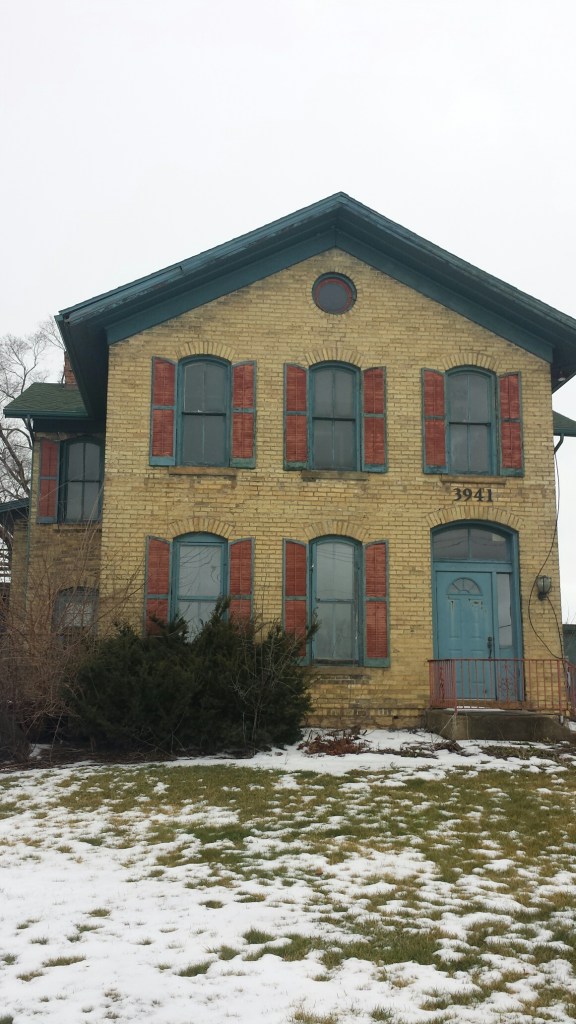
In 1870, Joseph and Lydia Spaulding built their house on the spot where Andrew Alger’s body had been found fifteen years earlier. It is unclear what ever became of Lydia Spaulding, but it is known that Joseph Spaulding died in this home on August 12, 1877. A large amount of paranormal activity has been witnessed at the Spalding House over the years and some stories date back to the when the house was first being built. Workers on the property would tell tales of a headless man seen walking in the tree line behind the house. Witnesses have reported the scent of fresh baked bread coming from the area that was once the kitchen. The most usual sighting is that of the apparition of a woman dressed in the clothing of the late 1800s. Some speculate that this could be Lydia Spaulding, but no one knows for sure. Whomever the spirit is, she seems harmless, as if she is simply watching over the property.
In its most recent history, the grand old house was home to an antique shop but it has since closed its doors. The house is currently vacant and is, at the time of this writing, up for sale. It is surrounded by a gas station, hotel, and a Cracker Barrel. It is zoned for commercial use and quite possible could be torn down to make room for modern construction once sold.
Make a one-time donation
Make a monthly donation
Make a yearly donation
Choose an amount
Or enter a custom amount
Your contribution is appreciated.
Your contribution is appreciated.
Your contribution is appreciated.
DonateDonate monthlyDonate yearly Jeffery W. McKelroy
Leave a comment