by Jeffery W. McKelroy
When leaving San Francisco, Heading north to Fort Bragg, you will take the 101. It only takes three hours to get there if you stay on this route and the interstate will take you through wine country or you can hop over to the 1. The 1 is the coastal highway. It only adds an hour more to the trip, but it is very much worth the added time in exchange for the beautiful view of the rocky coast.
In prehistoric days, the area now known as Fort Bragg was home to the native Pomo tribe. They were hunter-gatherers who lived close to the land and sea along the northern coast of California. In 1855 an exploration party from the Bureau of Indian Affairs visited the area looking for a site to establish a reservation. The abundant game and proximity to the sea made this an ideal location. In the spring of 1856, the 25,000-acre Mendocino Indian Reservation was established. In the summer of 1857, First Lieutenant Horatio G. Gibson, then serving at the Presidio in San Francisco, established a military post on the Mendocino Indian Reservation, approximately one and one-half miles north of the Noyo River. He named the camp for his former commanding officer Captain Braxton Bragg, who later became a General in the Army of the Confederacy. The official date of the establishment of the fort was June 11, 1857. Its purpose, like many others on reservations in the west was to maintain order on the reservation.
Gibson and Company M, Third Artillery left Fort Bragg in January 1859 to be replaced by Company D, 6th Infantry. They stayed for two years and continued to build up the post. In 1862 a company from the 2nd California Infantry assumed command. By 1864 the army had concluded that their presence was no longer needed in the area and in October of that year the entire Fort Bragg garrison was decommissioned and loaded aboard the steamer “Panama”. In March of 1886, the Mendocino Indian reservation was closed, and the land opened for settlement several years later.
The approximate boundaries of the old fort extend from the south side of today’s Laurel Street, east from the railroad depot to the alley behind Franklin Street, down the alley to a point 100 feet south of Redwood Avenue, then west on Redwood Street to just beyond the Georgia-Pacific Corporation company offices and then north to connect with the Laurel Street border at the railroad station. The only remaining building of the Fort Bragg military post that still stands is at 430 North Franklin Street. It was the Quarter Master’s storehouse and commissary.
By 1869 small lumber mills were being built at the mouth of every creek and ranchers were already beginning to settle the land. By 1873 the town of Fort Bragg had established a lumber port at the Noyo River. Soon after the fort was abandoned, the land of the reservation was offered for sale at $1.25 per acre to the new settlers. In 1885 C.R. Johnson who, with partners Calvin Stewart and James Hunter who had been operating a sawmill in Mill Creek, moved their mill machinery to Fort Bragg to take advantage of the harbor for shipping. The company was incorporated as the Fort Bragg Redwood Company. In 1893 it was renamed the Union Lumber Company.
The Fort Bragg Railroad was founded to haul logs to the mill. The first rails were run up Pudding Creek and in 1887 reached Glen Blair, another logging town that flourished until it permanently ceased operations in 1928. A San Francisco streetcar was purchased to carry loggers and their families on Sunday excursions to the woods. Fort Bragg was incorporated in 1889 with C.R. Johnson as its first mayor. Calvin Stewart laid out the first map for the town.
The Union Lumber Company was incorporated in 1893 by absorbing some of the smaller lumber companies in the area. Some of the new company lands were in the next valley east of town making removal of logs difficult by rail, this necessitated the building of a tunnel. Johnson imported, from Nevada, experienced Chinese tunnel builders. After completion of the tunnel, most of the Chinese decided to make Fort Bragg their home. A six-walled Chinese town was built at Redwood and McPherson. The children of those original Chinese settlers eventually grew up and moved on and Fort Braggs “China Town” eventually died out.
In 1901 the Union Lumber Company employed the National Steamship Company to carry lumber, passengers, and supplies. Fort Bragg’s location was remote and the only link to manufactured creature comforts and staples like sugar and coffee were from delivery by steamship as overland travel was still difficult and time consuming. In 1905 the California Western Railroad and Navigation Company was formed, and plans were pushed through to get the rail line all the way to nearby Willits, where train connections could be made for San Francisco.
The 1906 earthquake that devastated San Francisco also shook Fort Bragg to its core and resulted in a fire that threatened the entire city. Within the town itself, all brick buildings were damaged if not destroyed completely and many wood frame homes were knocked off their piers. The fire downtown burned the entire block bordered by Franklin, Redwood and McPherson Streets, plus the west side of Franklin. The west Franklin block burned down to approximately one half a block beyond the intersection of Redwood and Franklin but within only one year following the earthquake, all downtown reconstruction was completed. In a strange twist of fate, the earthquake brought real prosperity to Fort Bragg as the mills furnished lumber to rebuild San Francisco. With the new prosperity, the rail line to Willits was completed and in 1912 the first tourists came to Fort Bragg. A new industry was born and by 1916 Fort Bragg had become a popular destination for those looking to escape city life both temporarily and permanently.
Commercial fishing has also played an important role in the formation of the economic base of the town. Fort Bragg was at one time an important commercial fishing port, well known for producing quality seafood that was shipped to major metropolitan markets.
Fort Bragg continues to be a thriving community always moving forward but never forgetting its past. The pride of the community is evident in the beautifully manicured lawns and the well-preserved historic buildings. It would be easy to assume that nothing strange ever happens in a place like Fort Bragg but to make that assumption would be a mistake.
As day turns to dusk and the sun begins to dip into the sea, the salty air turns colder, inviting the fog that nightly, rolls ashore and creeps into town, muffling the sounds of cars and pedestrians. As night falls and the world becomes silent the spirits of the past awaken and walk the streets of Fort Bragg once more.
Everyone in Fort Bragg knows the former Grey Whale Inn is haunted but to past visitors who were not aware of its reputation, waking up to find a dark figure looming over the bed can be quite a shock. If you think about it, why would it not be haunted? The Inn was not always a bed and breakfast. It was built in 1915 and originally housed the Redwood Hospital, that included a morgue in the basement. For many generations this was the place where the citizens of Fort Bragg were born and where they died and there were many deaths here. Life out west was tough. The work was dangerous and infectious disease spread easily through close contact and a lack of modern medicine. A quite common story told by staff and guests was that of a woman in turn of the century clothing walking through the garden gathering flowers only to fade away when approached. Some frightened guests have looked at the home and seen an older very stern looking man in a grey suit looking at them through a window. Upon inquiry they would find that there is no one fitting that description working or staying at the B&B. Sadly the Grey Whale Inn is no longer in business and is in disrepair. Almost all of the long-time residents of this seaside town have connections to the old hospital and for the sake of preserving their history hope that it will soon be brought back to life. Until then, it seems that the spirits are watching over the old building.
The stories of the Grey Whale Inn are mild compared to those of the Glass Beach Inn. Built in the 1920’s this former private residence is home to a chair that supposedly carries with it extremely bad luck. It is said that anyone who has ever sat in the chair has met with an untimely death. I found a plethora of mentions about the ghostly happenings there, but it was difficult for me to find much real history that was beyond benign when it came to this very lovely home. I traveled to the area in the off season and so was able to be the only guest at the inn that night. I had heard the stories of the deadly cursed chair but was unable to get anyone to confirm its existence. I sat alone in the lobby, which was more of a living room, feeling amazingly comfortable. I felt as though I was staying the night at the home of a relative. Before retiring to my room for the night, I took a stroll around the old home. The atmosphere was very quiet and passive. I made it to my room. I made sure to push the door firmly closed behind me and heard the reassuring click of the bolt sliding into the opening of the striker plate. I began to remove my shirt when I heard another click behind me. The door was just ever so slightly open. I was a bit surprised and so I opened the door wider and looked out and both ways down the hallway. There was nothing there. I closed the door again and this time I tugged on the doorknob. It was firmly and absolutely closed. I then locked the door and went into the bathroom to take a shower. When I came out of the shower, I felt like something was out of place. I stood in the middle of the bedroom and saw it. The door was wide open. I closed and locked the door again. It took me a long time to get to sleep that night but eventually sleep came and there were no other strange occurrences.
While in Fort Bragg I had a chance to visit with a few employees of the Gold Coast Hotel which is supposedly frequented by mischievous spirits that move glassware in the bar and harass the employees by moving furniture and opening and closing doors. The employees laughed about most of their experiences and even had a few funny tales of them scaring themselves. The spirits at the Gold Coast seem to enjoy being part of the crew. Yolanda, a housekeeper told one of the best stories I had heard in a long time, “I was in a room, cleaning. I made the bed and then went into the bathroom. When I came out, the bed was unmade. I thought maybe I forgot to make it. So, I made it again. I went into the hallway to put my cleaning supplies back on the cart. I went back into the room and the bed was unmade again. At that point I went down the hall to get my supervisor. I brought her back to the room, explaining what was going on and showed her the bed which was now re-made! That was it. I closed the door to that room and didn’t go back in there.”
Are the spirits of the pioneers that founded Fort Bragg still here in some way among the living? Those that have seen and heard them for themselves believe whole heartedly that they are. As evening turns to night in this seaside town and the heavy marine layer fog muffles every sound and obscures the view, it is not hard for the mind to wander. It looks like the perfect setting for a ghostly tale. Those early loggers and camp workers from every corner of the globe came here chasing something that they could not find at home. They were willing to risk their lives in a battle with the forces of nature and other men to carve something out of the land that they could call their own. I suppose that if I were that passionate about it in life, if possible, I would continue to be so in death.
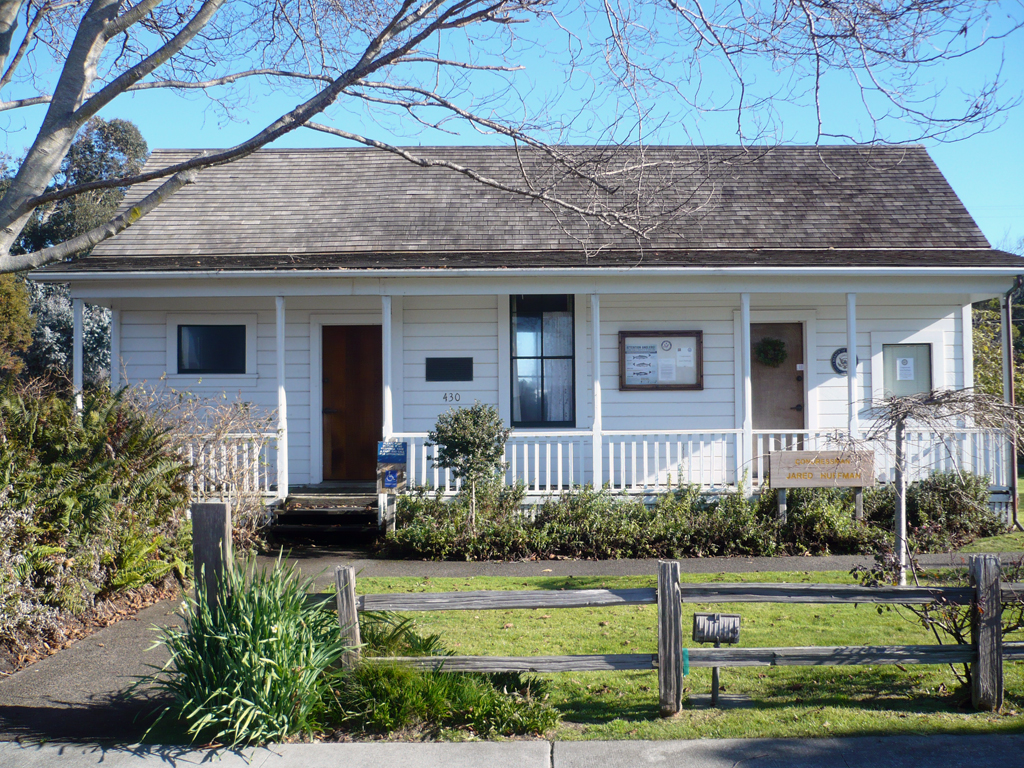
The old post Quartermaster storehouse
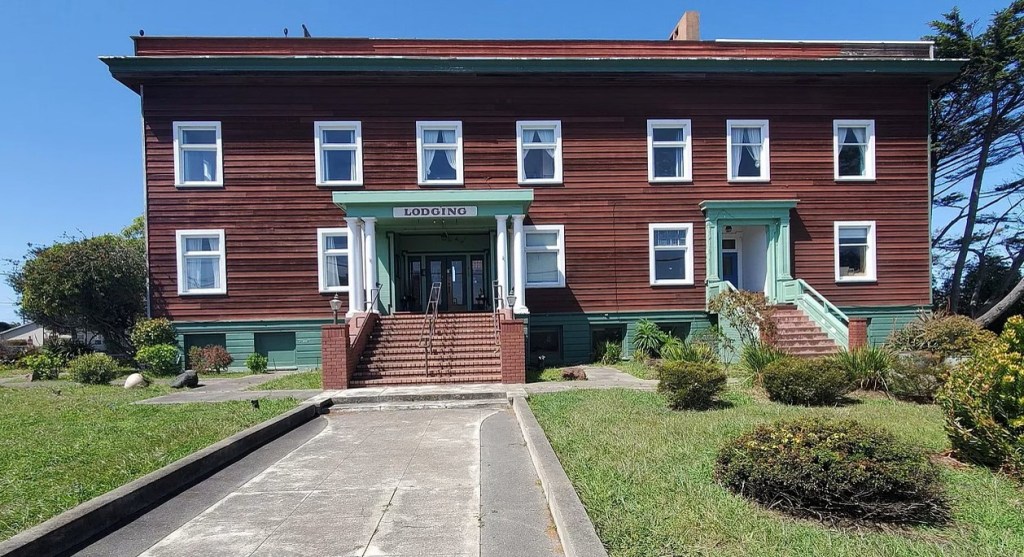
The former Redwood Hospital, now The Grey Whale
Make a one-time donation
Make a monthly donation
Make a yearly donation
Choose an amount
Or enter a custom amount
Your contribution is appreciated.
Your contribution is appreciated.
Your contribution is appreciated.
DonateDonate monthlyDonate yearly Jeffery W. McKelroy
Leave a comment