by Jeffery W. McKelroy
Traveling from Fort Bragg, California, if one heads east and into the mountains of Northern, California where gold was discovered in the 1840’s you will find the area dotted with ghost towns from the era of the Gold Rush. The winding roads must have been treacherous in those early days, but the lure of easy money will make most men risk almost anything. This trip was a special one for me. I would be returning to the scene of one of my personal paranormal experiences. The experience that first put the idea of a book about western hauntings into my mind. I wanted to see if I could recreate the experience or if maybe it was all some sort of rum soaked dream. I was about to find out.
During the Gold Rush, Mokelumne Hill was one of the richest gold mining towns in California. It was founded in 1848 by a group of Oregonians. The placer mines in the area were so rich that the miners risked starvation rather than head to Stockton to replenish their supplies for fear of losing their claim. Soon after its establishment, gold was discovered in the nearby hills, so much so that miners were restricted to claims of 16 square feet, and yet many of those claims were reported to have paid up to $20,000 each, which was quite a large sum in those days.
By 1850 the town was one of the largest in the area, with its population reaching as high as 15,000 with people of all nationalities. Americans, Frenchmen, Germans, Spaniards, Chileans, Mexicans, and Chinese poured into the town of Mokelumne Hill and the surrounding mountains in search of their fortune. There was a lot of racial tension in addition to the fact that the easy gold attracted criminal elements. The town gained a reputation as one of the lewdest in the area. Gun fights on the streets and near the mines were common. Many men lost their lives over disputed mining claims or accusations of cheating at cards. The notorious bandit Joaquin Murietta is said to have been a frequent visitor to the gambling venues until he lost his head, and it was put on display in a traveling side show for 5 cents a look. It goes without saying that violence was a major problem. In 1851, the town became legitimate when it opened its Post Office. That same year there was at least one homicide a week for seventeen consecutive weeks. The citizens could no longer stand the violence and so a “vigilance committee” was formed and by 1852, the worst of the crime was eliminated. That year, the town became the county seat.
The boom years were short lived and by the 1860s the gold started to run out and the town’s population and importance diminished. When San Andreas became the new county seat in 1866, Mokelumne Hill’s status declined even further. The town never regained its former glory, but it also never completely died out. There are still around 800 residents that call “Moke Hill” home and lovingly look after the remaining historic buildings. The original elementary school built in 1852 is now a private residence. California’s first 3 story building, the Odd Fellows Hall, is still there as is the oldest Congregational Church in the state. By far the most popular building in the area is the Hotel Leger.
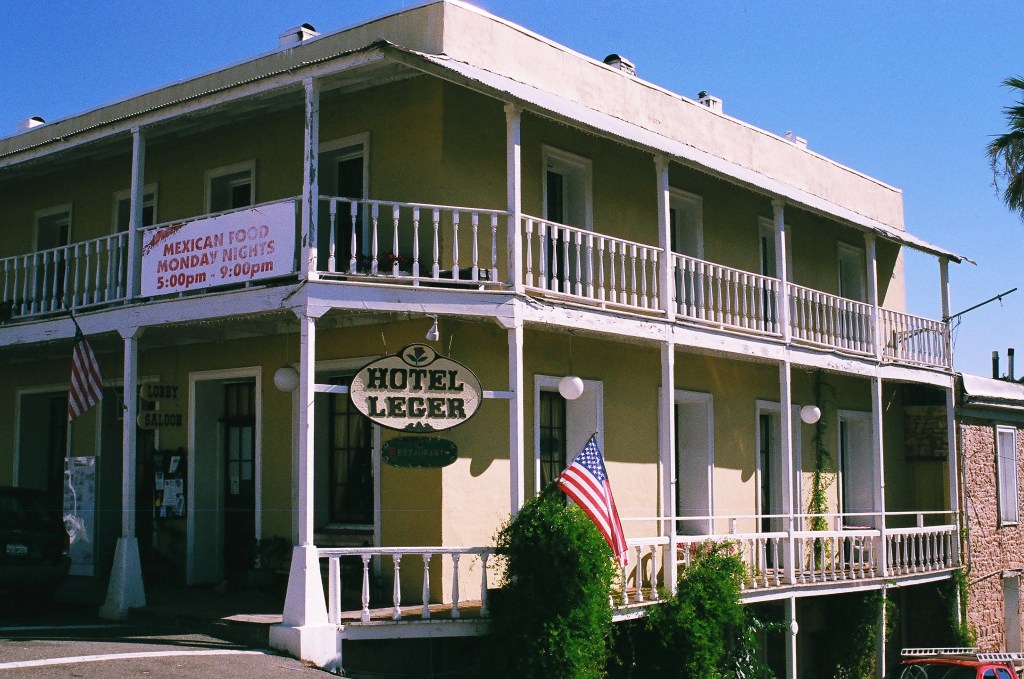
The Hotel Leger is one of the oldest continually operated hotels in California. One of its buildings was even the county courthouse at one time, complete with hanging tree out back and a jail beneath the hotel. George Leger first operated the hotel which was originally a wood-framed tent. In 1851, the hotel, then called the Hotel de France, initially catered to a large French population that had settled into Moke Hill during the Gold Rush. The hotel became a popular watering hole where prospectors came to drink and gamble. The usual currency during the boom years was gold dust and a secret passageway was built leading across the street to the bank. This kept the owners from having to carry the valuable dust in the open where they would be vulnerable.
The present hotel is housed in three separate buildings. The stone building that was once the courthouse is the only portion of the three-building structure that survived three devastating fires that razed most of the town in 1854, 1865 and 1874. Today the old courthouse contains rooms upstairs, a large room that once housed a small theater and the cellar, where the old jail cells are located.
The Hotel Leger has long had a reputation for being haunted. Stories are often told by people who swear to have seen something out of the corner of their eye. Unexplainable noises are often heard such as knocking on walls or the sound of heavy boots walking across the floor of an unoccupied room. Hotel guests have also reported waking up to find a frightening apparition standing in their room, only to watch as the specter disappears as they look more closely. More than one witness has claimed that Room No. 7, which was once George Leger’s personal domicile, is often where the unusual happenings occur. There are reports of furniture being moved and of the rocking chair rocking while no one is in it. Moaning can sometimes be heard coming from the old jail and witnesses have sometimes encountered foul odors and drastic changes in temperature in the old cells. In the area where the gallows once stood visitors get an uneasy feeling and sometimes become ill. There are also reports of a woman heard crying in the hallways. Though there is no official record it is said that George Leger’s wife died in childbirth, and some believe that her restless spirit is the source of the mournful sounds. There have been sightings of an attractive woman in Victorian clothing walking through room number 2 and a little boy seems to like to appear to guests in room 3. In rooms 10 and 11 the housekeepers are kept busy making and remaking the beds as the ghosts in these rooms seem to like them messy. The owners of the hotel have arrived in the morning to open the dining room to find it in complete disarray; tables and chairs have been moved and place settings disturbed.
While researching these stories, I drove up to Placerville, another haunted mining town, and then on to Mokelumne Hill and booked a room at the hotel Leger for the night. I figured I would kill two birds with one stone by researching both towns in one trip as they are only an hour apart from each other. When I arrived at the hotel the sun was below the horizon and the last light of day was quickly fading, dragging behind it the darkest star encrusted sky I had seen in a long time. I checked into room number 3, dropped off my belongings and rushed back down to the saloon for a quick bite before they stopped serving food. Everyone there, including the employees had apparently started drinking much earlier so rather than attempt to catch up with them I finished fast and returned to the room where I planned to do a little more research on the area. The room did look like something right out of the old west, there was no T.V., no radio, no phone. At night the staff locked up and went home, leaving me and the other guests alone until morning. In the large comfortable bed, I was able to fall asleep quickly but unable to stay asleep for long. I woke up at some point and was wide awake. I opened the floor to ceiling window and climbed out onto the balcony and sat for a while but still was not tired. So, I decided to break out my camera and venture out into the dark to attempt to get a few nighttime photos. It was pitch black, but my camera had a great flash. The streets of the old ghost town were completely abandoned. There were no lights, no people, no cars, just me and the night and the lonely street. I walked past the few buildings left in the town to the old town park. There isn’t much there just a green space and a stone monument. As I was leaning forward to try to make out the words on the monument’s plaque, I began to hear the sounds of horses. The origins of the noise were hard to discern due to the fact that it seemed to be echoing off of the buildings across the street from the hotel. Since it was echoing off these buildings, I assumed that it must be coming from the dark area of town behind the hotel. The horses sounded as if they were corralled, running in circles, whinnying, and neighing as if terrified by a coming storm or a wolf. Although not particularly scared, I was a little nervous in the dark alone with the possibility of some unseen predator on the prowl, so I decided to return to the room.
The next morning, I made the rounds taking pictures and asking questions of hotel staff and guests. I asked one of the staff where the horse corral was located and she looked at me, perplexed and replied, “Corral? There’s no corral.”
I went back to the end of the street to look around again, then made my way back to get ready for check out time. I sat down with my laptop and started searching the web for historic photos of the town. I was led to the town web site, and I found many interesting photos but the most interesting was of the old corral. In the 1880’s the buildings across the street were not there. They all dated to the early 1900’s. In that place was the very large city livery stable. The very distinct sound of the horses I had heard the night before, the sound I thought was an echo, was coming from the exact site of the old corral. As I sat there pondering the sounds of “ghost horses” my train of thought was interrupted by the curtains mounted 10 feet high, out of my reach, falling to the floor from both windows in the room to the floor. At that moment I decided it was time to leave. I packed my things somewhat hastily and checked out.
For those that have experienced the haunting at the Hotel Leger there is no doubt in their minds that the ghosts exist. Most do not feel threatened by their presence. They simply feel that maybe the spirits love “Moke Hill” as much as they do and really just don’t want to leave. I for one also believe, and I have also seen enough.
Make a one-time donation
Make a monthly donation
Make a yearly donation
Choose an amount
Or enter a custom amount
Your contribution is appreciated.
Your contribution is appreciated.
Your contribution is appreciated.
DonateDonate monthlyDonate yearly Jeffery W. McKelroy
Leave a comment