by Jeffery W. McKelroy
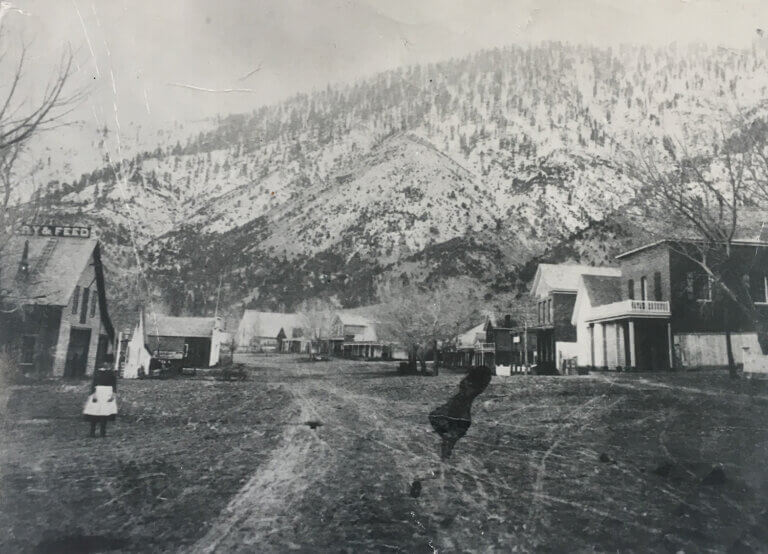
After leaving Placerville, I headed east over the mountains along the El Dorado Freeway to what was for many pioneers the last stop on their journey west before crossing the mountains into California and a new life. Although, if you reached this place at the wrong time of year it would either be your winter home, if you were smart, or the last time you see civilization as a living person.
The settlers, trappers and prospectors of the old west faced numerous perils on their way out west. For those who endeavored to reach the gold fields of California the last of the great obstacles was usually the Sierra Nevada mountains. At its base, on the Nevada, California border, a trading post sprang up. It was a place where the adventurers could rest and resupply before making the journey up and over the treacherous mountain range. It was the town of Genoa.
In 1851 John Reese constructed the first real trading post. Since most of those who had come out west with his group were Mormons, the original name for the camp was Mormon Station. The original cabin that was built by the settlers was the first permanent structure erected by non-natives in the state of Nevada. The town quickly grew up around it attracting permanent settlers who offered goods to those passing through. Prices were steep at the trading post for several reasons. The pioneers that were resupplying at the post felt that they were near the end of their journey and that fortune waited for them just over the mountain, so they were more apt to part with their money. They also knew that this would be the last chance to resupply for quite some time. The town had a blacksmith shop and a rather large corral for livestock. Reese stayed in Mormon Station until 1859 when his business began to decline after the Mormon leadership called all their faithful back to Salt Lake City to defend it against the advancing U.S. Army.
Over the years people of many nationalities passed through the area and a considerable number decided to stay. The Danish and German emigrants recognized the growing potential of the valley in which the town was located. They planted an abundance of crops to feed the residents and the travelers. The town and the valley in which it sits prospered. Increasing numbers of emigrants arrived, planting orchards, growing grain for livestock and building up the downtown streets of Genoa.
In 1910 a devastating fire engulfed much of the downtown. It started in what was then the poor house. It was a debtor’s prison located in an old hotel. An inmate in the prison lit a pan filled with sulfur in order to rid his mattress of bed bugs. He set the pan under his straw mattress and just a few glowing embers ignited his bed and eventually most of the town. When it was over several of the towns’ people were dead and the brick courthouse was just a burned-out shell. This was the first stage of failure of what was a growing and prosperous community.
In the years after the fire, the town of Genoa steadily declined. The courthouse was relocated to a neighboring town and so were most of the businesses. Times had changed. By 1916 the railroads had cut through the mountains to reach California cutting Genoa out of the equation for those heading west and the Gold Rush had been over for many years. There was simply no money and little interest in rebuilding.
Just as with any other frontier town, Genoa had its violent side. A testament to this storied past is the hanging tree. In the fall of 1897, the saloons of Genoa were beginning their busy season. Although the town had been in steady decline for years there were still some who crossed the mountains from Genoa. By fall, the snow would come to the mountains at any time, and it was best to just winter in Genoa. One day during this season a drifter with a reputation for being a nasty drunk with a quick temper by the name of Adam Uber was drinking at the Millerville saloon. He had been there all day and could barely stand up but continued to imbibe. A local Teamster by the name of Hans Anderson, who was well liked by everyone in town, saw an opportunity to playfully harass the lone miscreant. Anderson approached Uber, spun him around in his chair and to put on a show for the bar, shouted that he was going to knock him around a bit, for fun. Suddenly, without warning, Uber leapt from his perch, whipped out his pistol and shot Anderson. Hans Anderson slumped to the floor where he died. The patrons, having witnessed the murder, promptly secured Uber and lead him to the town jail.
As far as the drunken mob was concerned there was no need for a trial. His fate was sealed the moment he pulled the trigger. Hans was a well-loved local, only 26 years old and Adam Uber from California, was disliked almost universally. However, the local magistrate set the issue for trial. Uber sat in the jailhouse for a week, claiming that he had no recollection of the events that transpired as he was so intoxicated when it was alleged to have happened. When he woke up in jail, he initially thought that it must have been for public drunkenness and not for such a horrific crime.
One day before the trial was to begin, a drunken mob arrived at the jail around 2am. They banged on the door demanding entry but to no avail. After a time, they decided to use a sledgehammer and beat the door in. It worked. Once inside the jail the mob rushed. They met resistance from the Sheriff and the Constable, but the guards were soon overwhelmed and held at gun point by the angry mob. They found Uber’s cell, unlocked it, and though he attempted to fight back, ultimately bound and gagged him.
Wearing only a shirt, Uber was dragged a half mile through the streets of the town in the frigid November air. The final destination was what would forever thereafter be known as the hanging tree. At the base of the tree Uber’s shirt was ripped from him, exposing him to freezing winds; a noose placed around his neck. He was told that he had one minute to pray. Rather than pray, he issued a curse on all twenty-five of his executioners. He told them that a curse would befall them and their families and that it would last for seven generations. The executioners then pulled hard on the rope, lifting him high above the ground to strangle to death slowly. After his body stopped shaking, they took out their pistols and shot his body for sport.
When word of the lynching got out, the rest of the state was aghast. The governor issued a reward of $500 for the arrest of all of those involved. Although the reward offered was a hefty sum at the time, no one ever came forward and no one was ever held to account.
Of course, this is not where the story ends. As everyone in the west knows, a hanged man’s curse is the worst kind of curse. Although earthly justice was never realized, some believe that the ghost of Adam Uber came back for vengeance.
Over the years that followed the execution of the young drifter, those responsible all met an untimely end. Some died by their own hand, perhaps tormented by their own guilt, or possibly tormented by the spirit that they untethered from his mortal body. A few of the men were found dead with no explanation for the cause of death. They simply just stopped living. Others met tragic, horrific ends. One of the hanging party members was killed in a runaway horse accident and expired beneath the very tree where they left the corps of Adam Uber to swing in the cold November wind.
For many years later, the curse seemed to be true. Family members of the vigilantes continued for generations to experience untimely deaths, rare diseases and in general, just bad luck.
The spirit of Adam Uber may be finished carrying out his supernatural justice, but it seems as though he wants to ensure that the town never forgets what happened on that cold, dark early morning in November. To this day, his ghost is often seen standing at the base of the tree where he met his end. His spirit is also often seen pacing back and forth in the cell where he awaited his fate. The most chilling sighting though, is that of his apparition slowly, calmly strolling down the street toward the hanging tree. Some say that they can even hear him whistling a tune as he makes his way.
Today Genoa is a ghost town, a ghost town with a little spark of life. There are still a number of historic buildings and a very well-maintained park. Although the one local bar which is a favorite of road-tripping bikers is a bit rowdy there is also a candy shop and a few places to check out the local arts and crafts. The town cemetery, which is the last resting place of both Anderson and Uber, is as peaceful as it is beautiful. There are also a few once well-known trappers and adventurers resting there. If you are visiting Lake Tahoe, it is worth the trip over the mountain. As far as ghosts go, well, I had heard the stories before I went there. They were the usual type about lights in the cemetery, creaks, and groans in old houses at night, etc. As for me, I found the place too beautiful to think about such things for too long, even in the old cemetery. If the place is haunted, I would like to think that the ghosts must be happy where they are. If I had my choice in places to haunt, Genoa would be at the top of the list for places to spend time in the afterlife. Especially considering that once you leave Genoa to head over the mountain, the next stop is where the Donner Party met their end.

Make a one-time donation
Make a monthly donation
Make a yearly donation
Choose an amount
Or enter a custom amount
Your contribution is appreciated.
Your contribution is appreciated.
Your contribution is appreciated.
DonateDonate monthlyDonate yearly Jeffery W. McKelroy
Leave a comment