by Jeffery W. McKelroy
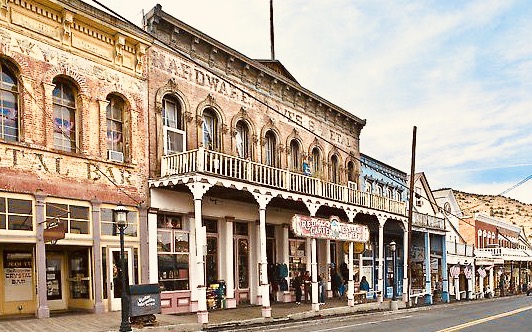
Virginia City, Nevada
Virginia City embodies the Old West of our childhood dreams. Surrounded by rocky barren hills, the town has retained the look and feel of a turn of the century mining town. While walking down its dusty old streets it is easy to imagine the Lone Ranger riding by in search of adventure.
The 19th century mining boom turned Virginia City, Nevada into the most important and prosperous, industrial city between San Francisco and Denver. It transformed the poor amateur prospectors from every corner of the country and the world into overnight millionaires. With their newfound wealth they built mansions, hospitals, churches, opera houses and schools. They imported the finest furniture, the latest fashions, and the best entertainment from Europe and the Far East. They helped finance the Civil War and went on to build empires around the world. San Francisco itself was built with Comstock silver.
The Ophir, Gould, Curry and Consolidated Virginia mines, those consisting of the “Big Bonanza” of 1873, brought out at least $300 million in mineral deposits and made telecommunications giant John Mackay an instant millionaire. In addition to Mackay, the “Bonanza Kings” included Fair, Flood and O’Brien. Other notable icons of the Comstock included engineer Adolph Sutro, banker William Sharon, entrepreneur George Hearst, and Madame Julia Bulette.
While the Virginia-Truckee Railroad transported bullion from the rural highlands of Virginia City to Carson City, the Territorial Enterprise, with literary genius Mark Twain, delivered news of the day to the ever-growing mining metropolis of 25,000 people at its peak. In 1868, Mark Twain reminisced and wrote about his journalism career in Nevada with the Virginia City Territorial Enterprise, “To find a petrified man, or break a stranger’s leg, or cave an imaginary mine, or discover some dead Indians in a Gold Hill tunnel, or massacre a family at Dutch Nick’s, were feats and calamities that we never hesitated about devising when the public needed matters of thrilling interest for breakfast. The seemingly tranquil ENTERPRISE office was a ghastly factory of slaughter, mutilation and general destruction in those days.”-Mark Twain’s Letters from Washington, Number IX, Territorial Enterprise, March 7, 1868-
Mining was a hard way to make a living, with 100-degree temperatures 3,000 feet down a mine shaft that required deep concentration from the person at the helm of the elevator. But the wealth of Virginia City helped finance the U.S. government during the Civil War, as attested by a museum named after General Ulysses Grant. In fact, silver from Virginia City may have helped save the Union. Although the arduous work was never ending, the people of the Comstock did find time to relax by attending performances at Piper’s Opera House, which still stands today. The citizens also played baseball and unwound after a long day at one of Virginia City’s twenty- two saloons.
It is said that the spirits of the people of the “Queen of the Comstock” still haunt the places where they lived, worked, played, learned, and died. Given the overwhelmingly beautiful backdrop and the intensity of the working and living conditions in this old west town it is not hard to imagine that it would be difficult for some of the former residents to be able to move on after death. Many of those that homesteaded here had traveled the world seeking their fortune and had been besought with many hardships in life before finally arriving here and fulfilling their life long dreams. Others came here only to find more hardship, never finding the riches they were seeking either through bad luck, carelessness or tragedy. If ever a place seemed as though it should be haunted, it is this one. Talk to anyone who lives here, and they will tell you that it is true.
Located on “C” Street, The Bonanza Saloon, is one of the handful of noted saloons that lines the wooden planked streets of this historic town. During its heyday following the gold and silver rush in Nevada, Virginia City grew from the ground up within a year of the discovery of the Comstock Lode. At that time there were numerous saloons to accommodate the untold numbers of prospectors who flocked to Virginia City in the hopes of finding either gold or silver during the 1860’s. Today the Bonanza Saloon is one of the few antebellum restaurant, bar and casinos lining the streets of this historic town. Although the saloon is now a modern tourist attraction it still has a very old west feel to it and it is not hard to imagine what it must have been like in the 1860’s. Looking around at the dark aged wood walls and floor it is easy to picture the saloon lit only by lanterns, smoke filled, smelling of cigars and sweat as a player piano played while miners and cowboys gambled away their hard won profits of the day. The employees and the occasional visitor believe that the spirits of those former patrons and employees still frequent the old saloon. There are many tales of moving objects and unexplained noises after closing. Stories are told of shelves stocking themselves the cash register opening on its own and glasses sliding across the bar, pushed by unseen hands. William, a former bar tender took the time to relate one of his personal experiences, “On one particular evening during inclement weather there was no one in the bar. I was reading a newspaper when I looked up to see a man sitting at the bar. Although, I never heard the man enter the bar, I just assumed it was because I was engrossed in the paper. I walked over to the gentleman, greeted him, and asked him what he would like to drink. The man replied that he would like a whiskey. I asked him what kind he would like. The man seemed somewhat perplexed. I then turned to the shelf where we keep the whiskey and began to name them. As I turned back around to see if the man had made a decision, I saw that he was no longer there. Without a sound, he was gone. The man was very well groomed although his face seemed weathered, and his eyes were squinty. He wore a black suit that was very clean but seemed dated as if from the turn of the century. This was the only strange experience I had but there are plenty of others with stories to tell.”
Another of Virginia City’s notorious and historic saloons is the Longbranch. In the 1880’s a young girl was run over by a carriage in the street in front of the saloon. A few of the citizens that witnessed the accident rushed to her aid and carried her into the saloon while a doctor was being summoned. This is where the little girl took her last breath. It is a local legend that the girl’s spirit never left the Longbranch. Her apparition has been seen by countless generations of employees and visitors. She is often seen playing on the third floor of the building. Another spirit said to haunt the old saloon is that of an American Indian known as Two Feathers. Legend has it that Two Feathers was drinking in the bar one night when a fight broke out between him and another patron. Two Feathers was getting the best of his opponent when the other man drew a pistol from his coat and shot Two Feathers to death in front of the bar. Visitors have claimed to see Two Feathers in the mirror behind the bar or walking near the slot machines. It’s said that after he appears the slot machines in the gaming area begin to malfunction or even shut off completely.
The local saloons are not the only haunted locations in this old mining town. Piper’s Opera House is also supposedly a repository for the restless spirits in Virginia City. It was opened in 1863 and was originally called Maguire’s Opera House. It burned several times and was rebuilt. Many famous performers of their day shared the stage here including Buffalo Bill. Today there are those that claim some of the performers never left. Stories are often heard of flickering lights in the dressing rooms and sightings of dark shadowy figures moving around backstage. Although smoking has long been banned in the theater, cigar smoke can often be smelled in the lobby area. One employee, Jennifer, reported, “I arrived early in the morning, alone. As I entered the lobby, I could hear the sounds of a performance in the theater and hear the sounds of clapping. I found this to be extremely odd, so I quickly threw open the doors to the theater and found that it was empty and dead silent. I was the only one in the building.”
At first glance Virginia City looks like the epitome of a western tourist trap town. With the glittery lights and the countless signs begging visitors to see their “Suicide Table” or other oddities it may appear a bit cheesy. But if you look past the noisy slot machines and the flashing signs and take notice of the historic old west architecture right in front of you it is not hard to see that this is a place with a history. Is Virginia City haunted? I don’t see why it wouldn’t be.
Make a one-time donation
Make a monthly donation
Make a yearly donation
Choose an amount
Or enter a custom amount
Your contribution is appreciated.
Your contribution is appreciated.
Your contribution is appreciated.
DonateDonate monthlyDonate yearly Jeffery W. McKelroy
Leave a comment