by Jeffery W. McKelroy

If you travel just a few miles northwest of Preston, Idaho along Highway 91 you will arrive upon the site of the Bear River Massacre. In terms of brutality and overall numbers of those killed, it was much more brutal than the better-known Battle of Wounded Knee, but because it took place at time when the nation was focused on the Civil War and the deadly Battle of Gettysburg, it went largely unnoticed.
It was the winter of 1863 when the Shoshone Nation, in their winter camp and long starving, were mercilessly attacked by a unit of the United States Army, The California Volunteers. The Volunteers were not happy about being left out of the fight against the Southern States and were eager to taste blood. They had been sent to the area to keep the peace between Mormon and non-Mormon settlers as well as the Indians who were being pushed off their land and were starving due to the scarcity of wild game. They felt cheated out of the glory that they deserved.
The official Army report of the “battle” claims that the Shoshone sustained around 250 casualties, but independent reports put the number higher at around 400.
The root cause of the massacre lies in America’s western expansion itself. The California and Oregon trails passed through the heart of Shoshone land. With so many white settlers passing through the area the wild game was becoming depleted and the Shoshone were being forced further and further to the edges of their ancestral home and any land that was viable for cultivation. The people were starving.
As a result of the widespread starvation of the native people they had resorted to raiding local farms for food and livestock. Brigham Young made an attempt at a sort of solution. He instructed his Mormon settlers to feed the Indians rather than fight them in an effort to assuage any blood shed but also possibly foster some good will. This helped some but the pressure of the ever-expanding population growth continued to put a strain on the ability of the natives to survive.
The Superintendent of Indian Affairs for the Utah Territory, Jacob Forney, contacted his superiors in 1859 with a proposal to establish a reservation with workable land for the tribe in order to relocate them and give them the opportunity to sustain themselves. He believed that as life became more difficult for the Shoshone and as more settlers arrived that the tension would become so great that there would be no way to avoid a violent conflict. The Department of the Interior was not swift to act.
Early in 1862 his replacement, James Duane Doty, decided to revisit the idea. He assessed that the Shoshone were starving and destitute and had been reduced to begging for food as well as raiding nearby cattle farms causing a considerable amount of resentment amongst the white settlers. Doty was able to procure some food supplies for distribution to the tribe, but it was the Civil War and resources were limited.
To make matters worse it was at this time that Col. Patrick Edward Connor arrived in Utah with his 3rd California Volunteer Infantry Regiment. He and his men had been ordered to Utah to protect the overland mail route and to continue the mission of keeping the peace in the area between Mormons, non-Mormons and the Indians.
Over the years there were several incidents that had ended in both dead immigrants and dead Indians. One incident that fanned the growing flame was when a Cavalry detachment detained four Shoshone Warriors as hostages. They ordered the tribal Chiefs to return cattle stolen from a local ranch or the warriors would be shot. On the next day the deadline passed without the return of the livestock and the men were executed. Their bodies were unceremoniously dumped into the Bear River. The Shoshone Chiefs had determined that feeding the rest of the tribe was more important than the lives of only four men and so had moved their people further north in the Cache Valley. Everyone knew that the show of force would only lead to more violence. One source speaking to a local reporter said, “The Shoshone are intent on killing every white man they should meet on the north side of Bear River until they should be fully avenged.”
There was a final incident between several miners on their way to Utah and the Indians. The miners were lost and unaware that they were in Shoshone territory and decided to camp a few miles from the main winter camp of the tribe on Bear River near present day Preston. One miner was killed along with several horses. The surviving miners returned to Salt Lake City and filed an affidavit recounting the gun fight and also detailing how 10 other miners had been killed three days earlier by the same Indians.
A warrant was issued for the arrest of Chiefs Bear Hunter, Sagwitch and Sanpitch. It was also requested that the U. S. Army assist in the apprehension of the Chiefs. At the same time the Mormon Leadership informed the Shoshone Chiefs that they would no longer back them and going forward would be backing the Army. Col. Connor and his Volunteers were finally going to get the fight they had been hoping for.
Col. Connor arrived on the scene around 06:00 in deep snow and temperatures dipping to around -20°F. He had with him a full complement of Infantry, Cavalry and Artillery. They were well supplied with around 16,000 rounds of ammunition and around 200 rounds of artillery. Perhaps due to the weather conditions, they were adept at advancing on the Indian encampment without being detected.
Col. Connor ordered a direct frontal assault as he did not expect much of a resistance, but his men were met with withering gunfire in defense of the Native position. In the first few minutes of the assault the Volunteers sustained heavy casualties and were forced to move back and regroup. Connor attempted to employ several flanking maneuvers, but it was to no avail until finally the Shoshone began to deplete their ammunition.
Once it was realized that the Shoshone were out of ammunition the advance was swift and deadly. The defenders did their best to fight back with arrows and tomahawks but were quickly overwhelmed. Once the male warriors were killed the Army turned its attention to raping the women and killing the children. Women who fought back against the rape were simply killed on the spot. The smaller children were killed by having their heads stomped in or bashed with rifle butts so to conserve ammunition. Babies were in general swung in the air and smashed against any hard surface available including rocks and trees. It was a frenzy of murderous rage. Not one prisoner was taken.
During the chaos there were a few who were able to run off to the woods and hide. Chief Sagwitch had been shot twice and attempted to escape on horseback, but his horse was shot out from under him. He then ran down a ravine and hid in bushes until night fell. Many others survived by pretending to be dead. The Shoshone dead numbered between 200 and 400 and the Volunteers lost 27 men.
The Shoshone would never recover from the incident. The survivors simply folded into the society of the immigrants who now ruled the land which was once theirs. Many of them were baptized into the LDS Church. Chief Sagawitch even became an ordained Elder. Some did move on to the Fort Hall Indian Reservation in Idaho.
The land where so much blood was shed is sacred to many and some even say that the spirits of those who were brutally massacred here still wander the sight of the winter camp. Tales are told of the sounds of babies crying or the disembodied screams of women and children. One traveler stopping alone to read the monument at the site told of hearing unintelligible whispering, disturbing enough that he quickly got back into his vehicle and left as quickly as possible. People who live in the area say that on misty mornings figures and faces of those who perished in the massacre can be seen in the fog.
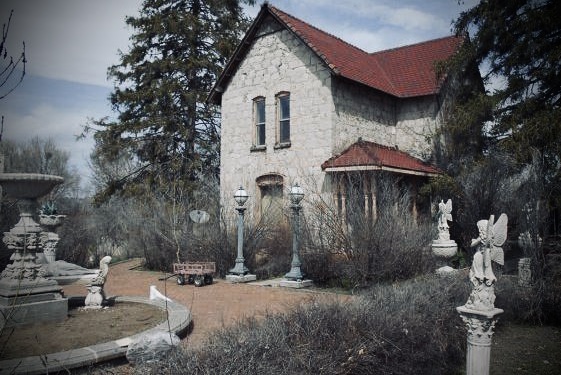
There are other hauntings in Preston as well. One such is the Franklin Mill House. The mill, constructed of rock and the six-bedroom home on Parkinson Road were built by James Mack in 1888. The Franklin Mill was destroyed twice by fire, first in 1921 and again in 1942. The ghost of one of the original residents, a woman named Mary, is said to frequently make her presence known. Mary was born in the house in 1892, in the exact room she now is said to haunt. Her father worked for the mill as one of the foremen, and their family was one of the first to live in the home after it was completed in 1890. She can be shy but shows herself to the owners of the mill and some of their guests. She stays on the second floor. One paranormal investigator I spoke with told me, “She likes her chair by the window. If you move it, she will move it back by morning.”
Visitors can smell her floral perfume, heavy in the air. Her favorite chair still sits near the window where she kept it in life. It is said that anytime it is moved it will be found back at the window having been moved by some unseen force. Mary is not the only ghost that lingers at the mill. Samuel Parkinson, who first owned the land on which the mill was built, is a regular ghostly apparition at the home and dwells on the first floor. He is a pushy man who isn’t as shy as his second-floor neighbor, and his favorite antic is touching people on the back. This has sent more than a few guests bolting for the nearest exit. The old train tracks still run next to the mill where workers would load flour onto the passing trains. Some people say ghost trains can still be heard passing through, and every now and then former workers will be seen getting on and off the train.
The spirit of an old farmer named Alex who reportedly died in 1922 is said to roam around King’s Variety Store on State Street. For quite some time Alex would shove items off shelves and occasionally throw something across the room. Eventually with the help of a medium the owners had a polite conversation with the ghost and asked if he would please stop the behavior. Since then, the spirit has been very quiet, only making his presence known by a sometimes creak in the floor or the slow opening of a door. It is also supposedly haunted by the spirits of several children and at least two ghost dogs. On one occasion a former owner walked into a room where she was alone to witness a book on a countertop laying open with some unseen hand flipping through the pages. The presence of the ghost children is felt so strongly and so often that the current owners have even taken to putting up a Christmas tree and leaving presents beneath it for them. They leave them unwrapped of course. It takes a lot of energy for a ghost to unwrap a gift.
It took a lot of hard work and perseverance to settle the west. There were many triumphant moments and many tragic ones as well. The pioneers endured animal attacks, war, prairie fires, blizzards, and any other number of hardships. The Native Americans lost their war and their way of life. With so much emotion spilled out into one place like Preston, Idaho, it seems that there is no way in which the spirits of those that came before would not have left their impression on the fabric of time.
Make a one-time donation
Make a monthly donation
Make a yearly donation
Choose an amount
Or enter a custom amount
Your contribution is appreciated.
Your contribution is appreciated.
Your contribution is appreciated.
DonateDonate monthlyDonate yearly Jeffery W. McKelroy
Leave a comment