by Jeffery W. Mckelroy
When we think of the Old West and westward expansion of the United States, we seldom think of the Pacific Northwest. I think most people tend to think of the striking images from old cowboy movies of wide-open desert terrain and brutal heat. The Pacific Northwest is just as important in the story of the old west as those told about the mines and ghost towns of Arizona or New Mexico. Often those places were simply where the pioneers were passing through to get to Washington, Oregon, Alaska, and the multitude of riches and natural resources that would shape their future and the future of the nation.
The Cascades Mountain Range extends from southern British Columbia through Washington and Oregon to northern California. The range consists of volcanic and non-volcanic mountains and is part of the Pacific Ocean’s Ring of Fire. Over the last 200 years all the volcanic eruptions in the United States have been from volcanoes in this range. These eruptions include Lassen Peak that lasted from 1914 to 1921and Mount St. Helens that occurred in 1980.
In Washington, the Cascades are dotted with ghost towns, reminders of a bygone era when men braved the elements, the wild and untamed west, and constant danger from bandits and Indians to find their fortune in the gold mines high in the mountains.
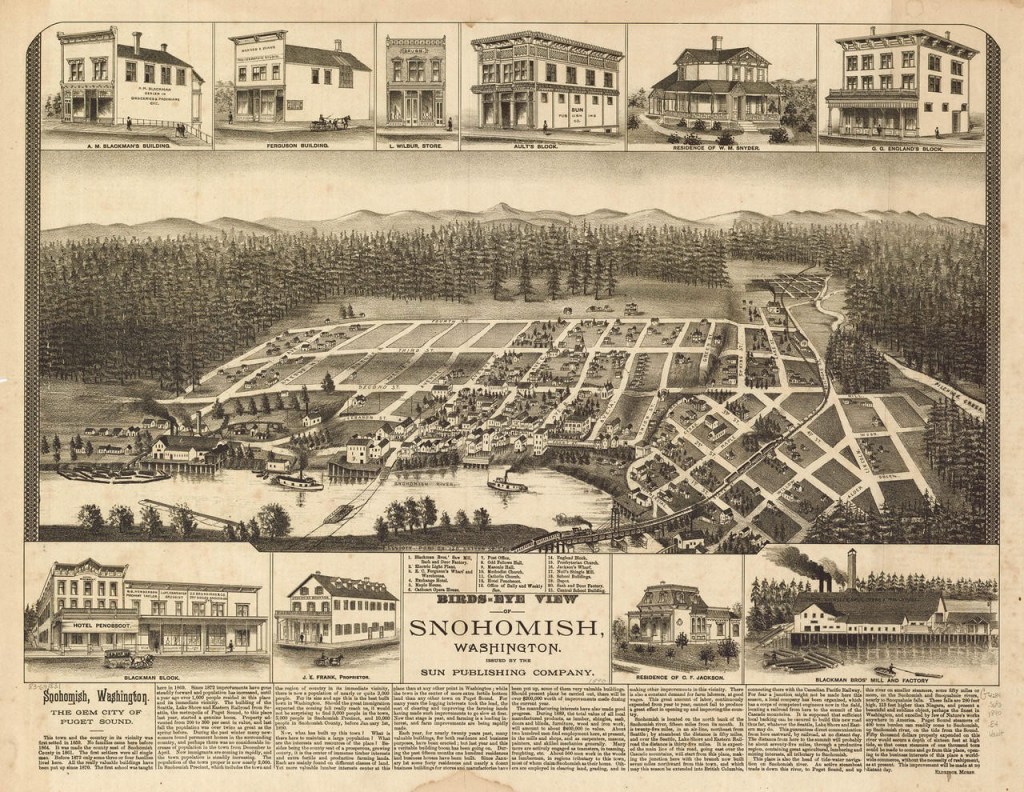
With 9,000 full time residents, the town of Snohomish is hardly a ghost town, and is a popular destination for day-trippers, mostly families looking to escape the city for the fresh mountain air and the tranquility and calm of a town that looks like it was created to be a replica of a Norman Rockwell painting. This peace and tranquility was hard won. It was carved out of the wilderness by the blood and bone of hard men who were determined to find glory or give up their lives fighting for it. That passion to conquer the great wild unknown and this area’s history of violent struggle may be why some say the entire town is haunted.
In January of 1855, Chief Pat Kanim, who had been appointed to represent the Snohomish, Snoqualmie and Skykomish tribes signed the Treaty of Point Elliot along with Chief Seattle. With this treaty they sold their land for cash and agreed to move on to a reservation called Tulalip. Soon after the signing of the treaty, and the departure of the Indians the first settlers arrived.
Some of the first settlers, Egbert H. Tucker, Heil Barnes, and Edson Cady traversed the heavily wooded terrain 12 miles up the Snohomish River to establish claims on both sides of the river. Their rudimentary maps lead them to the location where the Pilchuck river drained into the Snohomish.
Years before at a settlement called Steilacoom where the oldest military fort in the territory was located, a group of businessmen planned to establish a ferry service across the Snohomish River. The business idea was driven by the fact that funding for a new military road to Fort Bellingham had just been approved, and it would require safe and efficient passage across the river. The original site for the ferry crossing identified on U.S. survey maps would locate the ferry crossing at the Kwehtlamanish Winter Village. Edson Cady, decided to establish a landing several miles downstream as an alternative, because of the established Indian camp. Cady also applied for a post office permit with the name “Cadyville,”. Today this spot is called Cady Landing, which is a popular boat launch for recreational fishing. He also established a trail heading east, eventually crossing the North Cascade Mountain Range at a location still known today as Cady Pass.
With the outbreak of the Civil War the Army abandoned Both forts Steilacoom and Bellingham taking with them the funding for the military roads. With all the construction of the roads stopped there were only muddy paths through the woods and no need for a ferry. Most of the travel to and from the region would be accomplished by river travel.
Despite the loss of funding for the road and the loss of two major military forts, Snohomish County was established in January of 1861. The population was 49 men and 0 women. The Blue Eagle Saloon opened in 1865 and in the same year Mary and Woodbury Sinclair purchased the Cady claim and established a store of logging supplies.
Mary Low Sinclair was one of the youngest members of the Denny Party that arrived at Alki Point in 1851 at only 11 years old and was the first white woman to take up residence at the riverside landing.
Over the years the town slowly took shape and like any other town, schools and churches were built, a newspaper was established, and streets were laid out. The first newspaper, the Northern Star, was founded in 1876.
The Bennett & Witter Mill began operation on the Pilchuck River in 1876, and the mill was in business well into the new century as the Morgan Brothers Lumber and Shingle Mill.
Isaac Cathcart arrived in town following a footpath through the forest rather than by steamship. A large-framed Irishman, who immigrated in 1864, Cathcart had been working in the county since 1869, felling trees in isolated logging camps. He arrived in town four years later with enough money saved to build the Exchange Hotel at the west end of town. It was located across the street from the unfinished Atheneum building, which he eventually purchased, renaming it the Cathcart Opera House. By 1890, Cathcart owned a logging company, a store on the first floor of his opera house, and several large farms. He served as county treasurer, and eventually became the richest man in the county.
In 1884 The Seattle Herald reported that Snohomish was an “old town of about 700 inhabitants, with a two-story courthouse, a new sawmill, and one good school building, six saloons, and one church.”
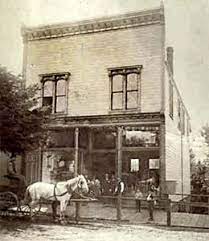
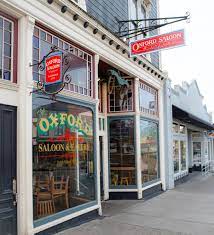
In 1900 the Oxford Saloon opened for business. The building was originally Blackman’s Dry Goods. The saloon saw many incidences of violence during its early years. At the time that it was remodeled as a saloon the owners added a vestibule to the entrance with a stairway leading to several rooms on the second floor to be used as boarding house rooms but, there are stories that say a prominent local businesswoman named Kathleen, rented them as a high-end bordello. She did not go into the saloon, but instead kept an office at the local Eagle’s Lodge, where she made reservations for her well-heeled clientele.
Over the years, the Oxford Saloon was often the scene of fist fights, stabbings, and gun fights. It was a well-known but unspoken fact that the basement was a men’s only card room. There were many fights and sometimes killings in the basement but everything was usually kept quiet as to not expose the prominent citizens that frequented the establishment, or draw the attention of the law or disapproving wives.
One well-documented killing was that of a policeman, named Henry. He was a regular at the Oxford and may have moonlighted as a bouncer. One night there was a fight, and when Henry attempted to break it up, he was stabbed to death. His death is the origin story for the spirit activity on the property. Shadowy figures and mysterious incidents have been reported here, most often the presence of the police officer, who is now seen and felt in the women’s restroom. He also tends to hang around the stairs leading to the basement. One ghost hunting group performed investigations here and, in these areas, recorded a large amount of Electronic Voice Phenomena and anomalies that appeared to take human form in photographs.
The second floor of the Oxford is today rented out as offices. It is reported that at least three ghosts seem to remain from the Oxford’s darker days. One apparition frequently seen is a man in a bowler hat that tends to give people a feeling of dread when he appears. There are also the spirits of two women. Some believe one is Kathleen, who eventually lived upstairs. She appears as an older woman. She is dressed in a purple dress with purple bows. The other woman is believed to be Amelia, one of Kathleen’s girls. Her dead body was found curled up in her closet, and no one was sure whether she committed suicide, or was murdered. Amelia’s room was room 6. The present tenants tell of furniture being rearranged overnight while the office is closed and of filing cabinets opening by themselves. Gail, an office worker on the second-floor refuses to be in the office alone after hours, “No way! I will not!”, she says, “There is something really wrong up there. You can feel it when you’re walking up the stairs. It’s almost like something is waiting to pounce on you. It gives me chills just thinking about it. I don’t even like to go to the bathroom alone.”
A child’s voice is sometimes heard on the second floor. Some have heard the child crying and some have claimed to hear the child laughing. No one can be sure as to whether it is a male or female child, and no one knows who the child may be. Russell, a maintenance man for the property doesn’t think much of it, “Yes. I have heard it. The kid. But it’s an old building and sound travels in funny ways. It could be kids outside and the sound is coming through the vents. I don’t know. Of course, its creepy but that’s just because its old.”
The Cabbage Patch restaurant in historic downtown Snohomish is another of the town’s well known haunted locations. It has been the scene of many investigations by professional ghost hunting teams. Employees and patrons have shared stories of a young, dark-haired girl in the upstairs dining room. She has been seen standing in the dining room and witnesses have even seen her from outside the restaurant, looking out of the windows. She has also been seen just standing on the stairs looking down at the floor below. Many believe that the spirit is that of a young girl named Sybil who fell down the stairs and broke her neck in the early 1930’s. All too often patrons and employees tend to trip without explanation on the last step at the bottom of the staircase. At one point a psychic investigator exploring the restaurant claimed that there was also a male entity that haunted the location. The psychic claimed that the spirit was that of Sybil’s uncle and that he may have actually pushed her down the stairs.
Paranormal investigative teams have captured quite a bit of electronic voice phenomenon on their recording devices as well. Many of the voices captured sound malevolent and often warn the investigators to leave the property. The spirit of a dog has been seen and felt in the restaurant, primarily by employees who feel him brushing against their legs. Employees claim to have had dishes moved or broken and often hear glasses being rattled when nobody is around. The haunting of the Cabbage Patch is very active. Although not everyone who visits this haunted location is witness to an apparition, almost everyone agrees that the restaurant always feels “alive”. Even when alone in the restroom, one never truly feels completely unaccompanied.
There are many other haunted locations in Snohomish. Almost every historic building in the historic downtown has a ghost story. Whether you are in search of ghosts or simply trying to escape the city for a while, the drive through the beautiful forests and mountains to this storied river portage is definitely worth it. Just be sure to take a friend with you to the restroom. Who knows what might be lurking in the next stall?
Make a one-time donation
Make a monthly donation
Make a yearly donation
Choose an amount
Or enter a custom amount
Your contribution is appreciated.
Your contribution is appreciated.
Your contribution is appreciated.
DonateDonate monthlyDonate yearly Jeffery W. McKelroy
Leave a comment