by Jeffery W. McKelroy
It’s a 9 to 10 hour drive, depending on your starting point, from the Cascades, east to Deer Lodge, Montana. The drive takes you through Spokane and the Nez Perce National Forest. It is truly beautiful. I wanted to spend more time in those areas but as I headed east, I knew that every mile got me closer to the next story and closer to home.
Deer Lodge is most well known as the home of the Montana State Prison which is the area’s largest employer. The Montana State Hospital in nearby Warm Springs and the former state tuberculosis sanitarium in nearby Galen were all a result of the rich mineral and copper deposits in the western part of the state. Deer Lodge was also at one time a very important railroad town and served as the headquarters for several railroads.
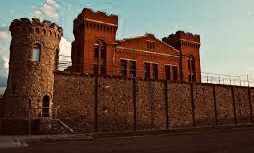
The former state prison located at the foot of Main Street is now the Old Prison Museum. As a bonus, it houses an antique car collection and a former electric locomotive called “Little Joe”.
The Old Montana State Prison towers over the landscape like a fortress. In the custom of the time, it was built in the gothic style. The very architecture was meant to be an imposing deterrent to seeking a life of crime as well as to impress upon those that resided there the absolute power of the state. It was supposed to make the inmate feel small and insignificant, to emphasize to those imprisoned that they had no power here. The worst part of it all, for the inmate, was that it was their labor that built the inescapable monster.
Montana was a wild place like most territories at the turn of the century and as the gold rush attracted more and more people from every corner of the world seeking their fortune, it became even more wild. Along with those in search of gold the territory also attracted thieves, gamblers, and every genera of nefarious characters. For several years after the discovery of gold in the area in 1862, the only law of sorts was enforced by the Montana Vigilantes. They appointed themselves police, judge, jury, and executioners.
During the winter session of 1866-1867 the Montana Territorial Legislature requested funding to establish a prison. The United States Congress approved the request and funded the building of the territorial prison at Deer Lodge. Funding was severely inadequate and so convict labor was utilized in the construction which began in 1870. The prison received its first inmate in the summer of 1871.
From its very inception the conditions of the prison were less than desirable. It was overcrowded as a result of the slow and seemingly never-ending construction that carried on for the next 50 years. In 1889 Montana was accepted into the union, becoming the 41st state. The prison was now the State of Montana’s responsibility. The State found that it was cheaper to contract out the operation of the prison. Thomas McTague and Frank Conley of Deer Lodge received the contract.
Frank Conley became the Warden and held the post for the next 30 years. He was a firm believer in requiring the prisoners to work. He kept them busy by employing them to improve the structure of the prison. They replaced the wooden fence with the current massive sandstone walls which are four feet thick, giving the prison a solid perimeter. They also added a log cell house to help in easing some of the overcrowding.
Inmates were also hired out for public and private work. This generated income for the prison and kept the incarcerated gainfully employed. Outside work was a privilege and the slightest infraction would send an inmate back to the prison and in this way the enjoyment of some relative freedom outside the prison walls helped to enforce good order and discipline.
In 1908 the prison experienced the first major escape attempt. Two inmates, William Hayes and George Rock decided on chancing it. They had been transported to the Federal Building for a hearing; as they were leaving, they attempted to flee. During the ensuing melee, Deputy Warden John Robinson was killed, and Warden Frank Conley was stabbed in the neck and back resulting in over 100 stitches. George Rock was hanged inside the prison that year as a result of the attempt. William Hayes met his end at the end of a rope the following year. Not only was “justice served” but the executions also served as a deterrent to others contemplating a similar attempt.
In April of 1959 overcrowding and poor conditions inside the aging prison led two inmates, Jerry Myles and Lee Smart to enlist 12 other inmates in an escape attempt. A riot ensued and in the battle for control of the facility Deputy Warden Theodore Rothe was shot and killed and Warden Powell was held hostage. The riot that they led lasted thirty-six hours and was only put down when the National Guard was called in.
The prison was finally closed in the 1970’s. The imposing stone building had served its purpose but by that time it was falling into disrepair and prison reform movements were requiring better living conditions for inmates as the country’s attitude towards the incarcerated was changing.
Although there are no longer prisoners in cells and guards roaming cat walks, many say that the old prison has not fallen completely silent. There have been sightings of dark and silent sentinels still standing watch in the guard towers. When employees of the museum go to investigate, the tower is silent and empty although filled with a heavy unseen presence that makes those who investigate the sightings feel very uncomfortable.
Many of the tour guides and other employees report seeing shadow figures out of the corner of the eye. Strange noises are often heard as the staff make their final walk through at the end of the night. In photographs, balls of light and strange anomalies show up to ruin pictures, both digital and film. In the main office the staff reports that paperwork is often missing only to turn up weeks later in odd places. Women often feel uncomfortable in the restrooms when alone and more than one female guest at the museum has heard her name called or felt an icy chill as she walks near the cells. Lights sometimes go on and off by themselves as do water faucets. Tour guides have said that while talking about particular inmates, cell doors will slam, or a cold blast of wind will be felt. In the area of solitary confinement visitors and employees feel a sense of foreboding and oppression. Some say that the air feels heavy, almost hard to breath. In the courtyard, the location of the old gallows, many guests feel a sense of terror or dread. To some the feelings are overwhelming, to others a curiosity.
The sounds of rattling chains and even what has been described as the sound of a baton being dragged along the bars of the cells has often been heard. The most reported sounds in the prison are the constant sounds of unintelligible murmuring. Those that have heard this say that they can never tell exactly where it comes from, only that it seems to be all around.
Dark shadowy figures dart from cell to cell and seem to be keeping watch over those who make their way through the facility. Visitors have said that they have seen dark figures out of the corner of the eye but when they turn to look there is nothing there.
The feelings of despair, depression and anxiety are often reported by visitors. It is not uncommon for someone to leave the tour early because they feel an all-consuming sense of dread.
One visitor to the museum, whom I spoke with told me a story of hearing what she described as the sound of bricks being scraped on concrete inside the jail. One little known fact is that prisoners who were deemed to be an escape risk were made to where shoes fitted with concrete soles. These shoes weighed as much as 20 pounds each and most certainly would cause someone to drag their feet along the concrete floor.
The shower is located in the basement and is still cold and damp. Shower time in the prison was a vulnerable time for many and today people claim to hear disembodied shouts and screams coming from the area.
Behind the heavy metal doors of solitary confinement, inmates were deprived of light, sound, and human contact. For all too many this was too much to endure, and they ended up losing their minds. So, it is no wonder that staff and visitors report hearing sobs and screams as well as banging coming from the old cells.
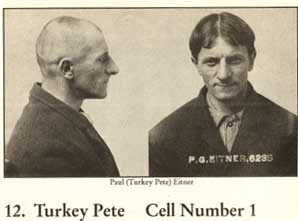
One of the more “famous” ghosts said to haunt the prison is that of its former “owner”. Paul “Turkey Pete” Eitner was convicted of murder in 1918 and sentenced to life in the prison. Pete was a model prisoner and for his good conduct he was given charge over the prison turkey flock. Over time he began to lose his mind. In his deteriorated mental state, he sold (so he thought) the entire flock of turkeys for 25 cents per bird.
As time went on and he became more delusional, the other inmates printed checks for him in the prison print shop he used these checks to “purchase” the prison. He commanded his kingdom from Cell #1 and paid the salaries of the guards and all prison expenses with his checks.
It is said that the spirit of Turkey Pete still roams the grounds, tending to his flock and managing the operation as he sees fit. His spirit has been seen in almost every corner of the facility and people have even heard him calling his turkeys. He seems to be content to remain here for eternity.
Considering the ghost of Turkey Pete, one could assume that he may choose to stay bound to the prison in death because in some way it was the only place that gave him a sense of belonging and control during his earthly life. As for the other spirits that haunt, maybe they are stuck here, bound by their sins. Maybe they are lost and confused. Maybe they are afraid to face what awaits them on the other side. Whatever it is that causes a place to be haunted, those that have experienced the plethora of phenomenon here swear by what they have seen. If you happen to visit the old Territorial Prison, take a moment to stop and listen. Who knows what you might experience? Try saying “Hi” to Turkey Pete. You never know. He might just say “Hi” back.
Make a one-time donation
Make a monthly donation
Make a yearly donation
Choose an amount
Or enter a custom amount
Your contribution is appreciated.
Your contribution is appreciated.
Your contribution is appreciated.
DonateDonate monthlyDonate yearly Jeffery W. McKelroy
Leave a comment