by Jeffery W. McKelroy
Situated just east of Capital Hill in Denver you can easily find the 80-acre Cheesman Park. It embodies the darker side of many of the tales of the Old West. At the conclusion of the Indian Wars in the 1880’s, western expansion and profit was at the fore of everyone’s minds. There was profit to be made for the bold and adventure to be had in a wide open country but this also made men greedy and the greed made men mean. This was the pervasive attitude until well after the Great Depression.
With its tree lined streets surrounding a beautiful park the residents of the affluent Cheesman Park neighborhood might have a hard time believing that in the late nineteenth century, the land that is now Cheesman Park was the infamous Prospect Hill Cemetery. The sprawling cemetery also included the land that is now the Denver Botanical Gardens and Congress Park to the east.
The cemetery opened in 1858 and the first burial occurred the following year. In 1872, the U.S. Government determined that the property upon which the cemetery was built was actually federal land, which had been deeded to the government in an 1860 treaty with the Arapaho Indians. Rather than demand that the cemetery be moved the federal government sold the land to the City of Denver for $200. As time went on and the cemetery expanded, different sections of the cemetery were designated for different religions, ethnic groups, and fraternal organizations such as the Odd Fellows, Masons, Catholics, Jews, the Grand Army of the Republic, as well as a segregated section for the Chinese. Some sections were well maintained by family or the fraternal and religious organizations, but others were terribly neglected. In 1875, twenty acres at the northeast part of the cemetery, east of where the botanic gardens are now located, were sold to the Hebrew Burial Society, who then maintained it, while much of the rest of the graveyard fell further into disrepair. By the late 1880s the cemetery was rarely used and had become an eyesore in what was quickly becoming one of the most exclusive parts of the growing city. Real estate developers soon began to lobby for a park to be put in its place, rather than a rundown cemetery. Before long, Colorado Senator Henry Teller persuaded the U.S. Congress to allow the old graveyard to be converted to a park and in January of 1890, Congress authorized the city to vacate Prospect Hill Cemetery.
Families were only given 90 days to relocate the bodies of their loved ones to other cemeteries. Those who could afford to, began to transfer bodies to other graveyards throughout the city and elsewhere in the country. Because of the large number of graves in the Roman Catholic section, the mayor authorized the sale of the 40-acre tract which was then named Mount Cavalry Cemetery, to the archdiocese. The Chinese section of the graveyard was given to the large population of Chinese who lived in the “Hop Alley” area of Denver. Most of these bodies were then shipped to their homeland of China. Several years went by while the city waited for citizens to remove the remains of their families, but few did. Most of the people buried in the cemetery were poor immigrants far from home not to mention vagrants, criminals, and paupers, which is why more than 5,000 bodies remained unclaimed. In 1893 The City of Denver then awarded a contract to undertaker E.P. McGovern to remove the remains. McGovern was to provide a new coffin for each body and then transfer them to the Riverside Cemetery for a fee of $1.90 each. The macabre work started in March of 1893. All the while a large audience of curiosity-seekers and reporters came and went. In the beginning the transfer was orderly. However, the unscrupulous McGovern soon found a way to make an even larger profit. Rather than using full-size coffins for adults, he used child-sized caskets that were just one foot by 3½ feet long. This was done, at least initially, due to a coffin shortage caused by a mining accident in Utah but also because the city was paying per coffin removed. By hacking the bodies up, McGovern could split the remains between several child size caskets rather than one adult coffin. In their haste, the grave diggers had caused body parts and bones to be strewn everywhere in scattered disorganized piles. This also allowed souvenir hunters and onlookers to help themselves to valuables from the caskets. The local papers caught wind of the story and described the goings on as “The work of ghouls”. They told in detail of the horrific scene, describing tattered clothing and severed limbs strewn around broken coffins. The people of Denver were horrified. The mayor canceled the contract, and the city began an investigation. Though a great number of graves had not yet been reached and others sat exposed to the elements, a new contract for moving the bodies was never awarded.
The city built a temporary wooden fence around the cemetery and in 1894, moved forward with construction of the park, though there were still several open graves. Later shrubs were planted, and the holes filled where coffins were removed. Without ever having moved the rest of the bodies, work was completed in 1907. In 1909, Gladys Cheesman-Evans, and her mother, Mrs. Walter S. Cheesman, donated a marble pavilion in memory of Denver pioneer, Walter Cheesman. The donation was conditional that the park be named Cheesman Park.
In 1950 The Catholic Church moved most of the remains of those buried in the Mount Cavalry Cemetery and sold the land back to the city. This land is now the location of the Botanical Gardens. In November 2008, during the initial construction of a new parking structure, human remains, and parts of coffins were unearthed. Construction was halted and all bones found thus far have been catalogued and interred at Mt. Olivet Cemetery in Wheat Ridge.
The Cheesman Park neighborhood is one of the oldest in Denver and remained somewhat exclusive for many years. By 1915, with the completion of the park, the neighborhood was well developed with large mansions for some of the city’s wealthiest people. Since the 1930s however, the neighborhood has become dense with apartment buildings and is now an eclectic colorful community. The park itself attracts thousands of visitors every year who know nothing of its gruesome past. The residents, however, know the story all too well. Some of the residents of the Cheesman Park Neighborhood believe that it is the area’s past that is to blame for the strange things that seem to happen in the park and in the surrounding homes and businesses.
One of the spirits said to haunt the park is that of the second man buried in the old cemetery, John Stoefel. There are several different accounts of what led up to him murdering his brother-in-law. While the stories don’t agree it is certain that the murder took place and Stoefel was hanged for it. At the time of the murder in 1859 Denver only consisted of about 150 buildings and there was no official court. The local vigilance committee convicted him and passed down the sentence of death. He was taken to a cottonwood tree at the intersection of 10th and Cherry Creek and the sentence was carried out. He and his victim were then buried together in the same grave. Witnesses have claimed to see a man dressed like a prospector walking through the park at night with his head hung low, gun in hand disappearing near the old pauper’s field.
Another local haunting is attributed to the ghost of a handsome Irish gambler named Jack O’Neal. In 1860 O’Neal argued over a card game with a man of questionable character who went by the name of “Rooker”. The argument became heated, and O’Neal suggested the two should settle the argument with their knives. When Rooker refused the invitation, O’Neal tried inciting the man to anger by insulting him and his family but to no avail. Rooker would not fight. A few days later with the entire incident forgotten by O’Neal, he was passing by the door of the Western saloon when Rooker unseen to him drew his pistol and shot him down without warning. For over one hundred years people have told of seeing the apparition of Jack O’Neal still looking to avenge his murder.
Reports of paranormal activity in the park began almost as soon as the relocation of the bodies began in 1893. One of the first witnesses was a grave digger by the name of Jim Astor. Astor had been looting the coffins as he removed the bodies. While at work one day Astor felt a hand on his shoulder. Upon turning to look there was no one there. Whether it was his own guilt or a truly unhappy spirit we will never know, but we do know that Astor never returned to work in the graveyard.
Another strange tale from the early days of the relocation comes from those living in residences surrounding the graveyard. They began to report sad and confused looking spirits knocking at their doors and windows, as well as the sounds of moans apparently coming from the still yet open graves.
Today the haunting continues in the homes that surround the park and the park itself. Most unsettling are the sightings of children playing in the park at night that mysteriously fade away into the shadows along with strange shadows and misty figures that appear and disappear. It is believed that there are still around 2,000 unclaimed, forgotten graves under the park. I visited the park in the daylight hours. I wanted to walk the grounds and get a feel for what is still the resting place of many forgotten souls. It was a balmy spring day with only a few clouds in the sky. It was the perfect day for a stroll in the park. There were quite a few people out enjoying the weather but there was not as much noise as you would expect. All sounds in the park seemed hushed and voices seemed like whispers. It felt like a graveyard. Perhaps it only felt this way because I knew the history and deep down, I felt a little empathy for those that had no family to claim them and so, were still under the footpaths that I was now walking on. Are the spirits of Denver’s original residents haunting the park and surrounding neighborhood? I cannot say for sure if that is true. Maybe knowledge of the gruesome history of this place causes one to immediately assume that the cold draft or strange sound from another room could be the spirit of a long dead prospector looking for his headstone. The next time you are in Denver, stop by the park and take a walk. Who knows what you may discover?
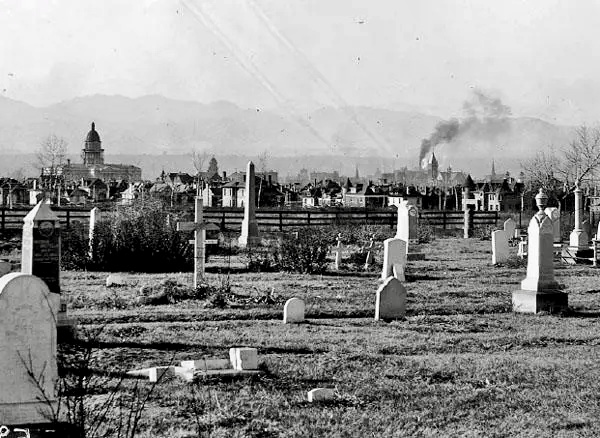
Prospect Hill Cemetery

Cheeseman Park today
Make a one-time donation
Make a monthly donation
Make a yearly donation
Choose an amount
Or enter a custom amount
Your contribution is appreciated.
Your contribution is appreciated.
Your contribution is appreciated.
DonateDonate monthlyDonate yearly Jeffery W. McKelroy
Leave a comment