by Jeffery W. McKelroy

In the heart of historic Mobile, Alabama, stands the majestic Battle House Hotel, a relic of Southern elegance and charm. Its corridors echo with the whispers of the past. Among the opulent decor and grandeur, there lingers chilling tales of restless spirits and forgotten lives stained by jealousy, love, and lost hope.
The Battle House Hotel in its current form was built in 1908 after a tragic fire in 1905 destroyed the original Battle House which was built in 1852. There were two wooden framed hotels built on this site, the Franklin Hotel, and the Waverly Hotel and both ended in fire.
The first Battle House Hotel was built by James Battle and his two half-nephews John and Samuel on November 13, 1852, on the site of the previous hotels but the site was also that of the former military headquarters of Andrew Jackson during the War of 1812. The hotel was a 200-room four-story brick building, with a two-story gallery of cast iron.
The hotel has hosted many notable events as well as distinguished guests. Stephen A. Douglas was a guest of the hotel the night that he lost the presidency to Abraham Lincoln. The first Battle House also hosted such notable guests as Henry Clay, Jefferson Davis, Millard Fillmore, Oscar Wilde, and Winfield Scott. A National Weather Service station was established at the Battle House Hotel in 1880 and electric lighting was added in 1884. The hotel was renovated in 1900. Then, after more than 50 years in service, the hotel burned to the ground on February 12, 1905.
After the fire, the proprietors hired Frank Mills Andrews of New York City to design a new structure and it was built out of steel and concrete with marble and brick facings. At street level it features a projecting one-story portico with paired Tuscan columns; the level above the portico has recessed Tuscan loggias with individual window balustrades. A wide third-story molded entablature is surmounted by cast iron balconies. The window openings over the entire facade have articulated keystones and the openings on the seventh level also feature cast iron balconies. The roof level features a molded projecting cornice with scroll brackets. The hotel lobby features a domed skylight. The ceiling and walls feature elaborate plasterwork and are also painted using the trompe-l’œil technique. The walls are painted with portraits of Louis XIV of France, George III of the United Kingdom, Ferdinand V of Castile, and George Washington.
The new hotel reopened for business in 1908. The hotel remained a prominent fixture of Mobile through the first and second World Wars. Woodrow Wilson stayed at the Battle House in 1913. It was while he was at the Battle House that he made his famous statement, “the United States will never again seek one additional foot of territory by conquest”. The hotel was renovated in 1916 and again in 1949, with air-conditioning added in all guest rooms and public spaces at that time. The lobby floor also hosts the Crystal Ballroom. At one time it was the hotel’s restaurant. The room has been restored to vintage colors, as it was in 1908. It features ornate plasterwork with an agricultural theme. The Battle House was a favorite place for southern planters to get away to once their crops were planted. The Crystal Ballroom is now used for social events such as weddings, meetings, and Mardi Gras balls. The first Mardi Gras ball to be held at the Battle House was The Strikers Ball in 1852. At that time the balls were part of the New Year celebration.
Sheraton Hotels bought the Battle House in 1958 and operated it as the Sheraton-Battle House until 1968, when they sold it to Gotham Hotels, along with seventeen other aging properties, and the hotel regained its original name. In May 1973, it was bought by local citizens, who renamed it the Battle House Royale and planned a complete renovation. However, the hotel was unsuccessful and closed its doors in 1974, remaining closed for the next 30 years. The empty Battle House Royale building was added to the National Register of Historic Places in 1975. By 1980 it was the only building left completely intact in its city block. In 2003, Retirement Systems of Alabama began restoration of the hotel, along with the construction of an adjoining skyscraper office building, which also includes additional hotel rooms on its lower floors, the RSA Battle House Tower. After the 2-year historic restoration was completed by Smith Dalia Architects, the hotel reopened on May 11, 2007, as The Battle House Renaissance Mobile Hotel & Spa.
This beautiful historic building is not only historically significant but according to many witnesses is also haunted. Despite the tales of hauntings, the Battle House Hotel remains a popular destination for travelers seeking a glimpse into the past. For many, the stories of spectral guests roaming the halls only add to the allure, drawing them back time and time again to experience the reverberations of a bygone era.
One of the most well-known ghost stories of the Battle House is that of the “Lady in Red”. In 1910 a newly married couple took up residence at the hotel. After having been at the hotel for barely two months the husband was called away on business. He assured his young wife that he would return shortly. He left her with some money and assured the hotel that he would pay the bill upon his return. Days turned into weeks and weeks into months and there was not even so much as a letter from the husband. The young bride’s happiness faded into despair. The hotel was demanding payment of the bill, there was no money left and no word from her husband. She was alone, helpless, and hopeless with no way of knowing what had become of the man she married. Had he met some terrible fate, or had he simply abandoned her? She had no way of knowing. At last, either way, it was all too much. The young lady could no longer stand the deep despair she was in and so hanged herself in the Crystal Ballroom in an elegant red dress that her lost love had given to her as a gift. Since that tragic day, guests of the Battle House Hotel spoke of strange occurrences—flickering lights, ghostly whispers, and the feeling of being watched by unseen eyes. Some claimed to have seen the ghostly figure of a young woman wandering the halls, her mournful gaze fixed on the door of a long-abandoned room. Guests to events at the hotel are always advised to keep an eye on their photographs. They just might spot an unfamiliar, mournful woman in a red dress, looking for her lost husband.
Another well-known ghost of the Battle House Hotel is that of Henry Butler. On August 22, 1932, twenty-seven-year-old Henry M. Butler, Jr., a local real estate broker, agreed to meet a potential client in Room 552 of the hotel. Unfortunately for him, this “potential client” was the husband of a woman he had had an affair with two years prior. In True Mobile Fashion, the lovers met while serving together in the 1929 Mardi Gras Court of King Felix III. The affair wasn’t particularly long lived, but its effects might have been. Mr. Raymond Dyson had reason to believe that, not only had Henry been “overly friendly” with his wife, Dorothy Grassfield Dyson, but that Henry might be the true biological father of he and Dorothy’s young son, born in July of 1930. Understandably this was upsetting, so much so that Raymond and his brother, Sam, decided to lure Henry to the hotel room and teach him a lesson. No doubt Henry realized he was in for some trouble when he recognized Sam, whom he knew, although it is doubtful he had any idea exactly how much. If he had, he may have had a different answer to Raymond’s question of “when exactly were you having an affair with my wife?” than “That’s none of your damn business.”
That flagrant retort immediately caused a scuffle, with Raymond punching Henry so hard in the face he broke his glasses. At this point Henry realized he was in some serious trouble and attempted to call for help, but after a bit more fighting the brothers gagged and restrained him. They then continued to brutally beat him until he was unconscious, at which point they dragged him to the room’s bathroom and quickly left the hotel. When Henry was found by hotel staff some hours later, he had died. Despite overwhelming evidence and even confessions, the brothers were acquitted and allowed to go free. This was largely due to Dorothy openly admitting her affair on the stand, which caused the Court to rule in favor of an “Unwritten Law” of the time, which was the understanding that a man was justified in killing his wife’s lover. The hotel underwent major renovations in 2003, at which time many single rooms, like Room 552, in which Henry was killed, were combined to make larger suites. Some believe this significant change has left Henry’s wandering soul at a disadvantage, and guests and staff alike report that he is known to rattle doorknobs of rooms on the fifth floor, trying in vain to find his way back to Room 552.
While researching this story I dined in the Trellis Room, the hotel’s restaurant. It was January, the off season. Aside from myself there was only one other table, and the hotel was virtually empty. This gave me the opportunity to talk with my server and other staff members as they were thoroughly bored. Everyone, it seemed, had a personal ghost story, or could at least relate the stories that guests had told them. During renovations of the hotel the work men were constantly harassed by spirits that impeded their work by causing tools to go missing or the power to be shut off. It was also difficult to keep construction workers on the project as many seemed to be frightened off the job.
Everyone I spoke with believed that there are spirits that roam the halls of the old hotel. Most everyone agreed that they are comfortable with them, as unsettling as the flickering lights or disembodied voices may be. They say that it is somewhat comforting to know that in some way their spirits go on, even after the life that we know is over.
The Battle House Hotel has existed in many different forms and continues to survive to this day, just like the spirits that remain there. The architecture is beautiful, and the atmosphere is peaceful. I can understand why someone might want to hang around here in the afterlife.
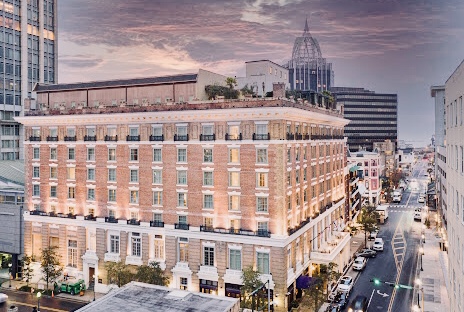
The Battle House Hotel
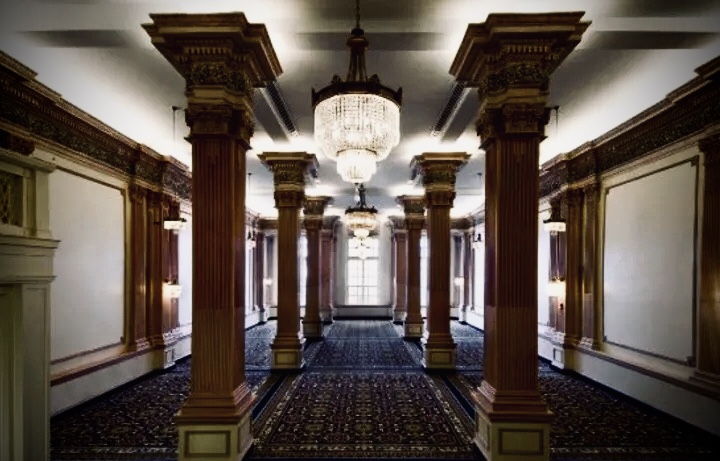
The Crystal Ballroom
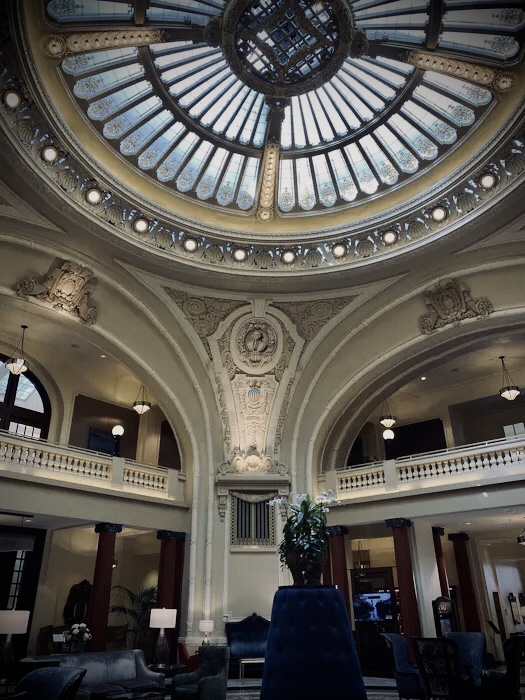
The lobby
Make a one-time donation
Make a monthly donation
Make a yearly donation
Choose an amount
Or enter a custom amount
Your contribution is appreciated.
Your contribution is appreciated.
Your contribution is appreciated.
DonateDonate monthlyDonate yearly Jeffery W. McKelroy
Leave a comment