by Jeffery W. McKelroy
The Gulf Coast of Mississippi is known for fun in the sun. Tourist shops and restaurants line white sandy beaches where they meet the brown water of the Gulf of Mexico. That brown water is the repository for some of the best seafood in the world. All along the coast from Bay St. Louis, Mississippi to Pensacola, Florida you will find not only great food but also great music. There is, however, one town along this stretch of coastline that may have something a little other worldly happening. That town is Pascagoula.
Pascagoula is a Native American word meaning “Bread Eater” and was the name by which the local tribe was called when they first encountered the Spanish explorer Hernando de Soto around 1540. Although he did note that they lived in several villages along the Pascagoula River, he did not make note of much else concerning the inhabitants of the area. Almost all the coastal tribes were peaceful and later in the 1700’s the founder of the colony of Louisiana, Pierre Le Moyne d’Iberville would observe that they were also timid and friendly.
The first detailed account of the Pascagoula people is that of Jean-Baptiste Le Moyne de Bienville, the younger brother of Iberville, whom the Pascagoula visited at Fort Maurepas at the sight of what is now the city of Ocean Springs, shortly after it was settled and while the older brother was away in France. Not much is known about these people, except that their language seemed not to have shared an etymological root with the larger native groups to the north, the Choctaw particularly. Their language did seem similar to that of the Biloxi Indians. This language, now extinct, was a Siouan language, which is related to the languages spoken by the Sioux, Crow, and Ho-Chunk. It is only speculation that the Pascagoula may have been related to the Biloxi as there is no surviving documentation of their language.
The region changed hands many times over the next 100 years. It was occupied by the English, French, and Spanish until well after the American Revolutionary War. At one point, for 74 days in 1810, Pascagoula was a part of what was known as the Republic of West Florida after those who had settled the area became tired of the border disputes between the Spanish and the fledgling United States and declared independence. It came into the permanent possession of the United States in 1812 when it was added to the Mississippi Territory. Pascagoula was officially incorporated as a village in 1892. It obtained city status in 1901. Today’s downtown Pascagoula was once the town of Scranton, Mississippi, incorporated in 1870. The two towns merged in 1904.
Pascagoula has a colorful history full of pirates and battles between the Americans, British, Spanish and French. It has survived hurricanes and wars and has played a major role in building ships for the U.S. military. There is another story though. It is a story that has inspired books and movies and documentaries. It is the story of one night in 1973 when two local boys who probably never thought much about wandering too far from their Mississippi home were taken much further than they ever thought they would go.
On the evening of October 11, 1973, 42-year-old Charles Hickson and 19-year-old Calvin Parker, both local shipyard workers, told the Jackson County, Mississippi Sheriff’s office they were fishing from a pier on the west bank of the Pascagoula River when suddenly they heard a whirring sound. Two flashing blue lights appeared overhead, and they observed an oval shaped object 30–40 feet across and 8–10 feet high. Parker and Hickson claimed they were “conscious but paralyzed” while three “creatures” with “robotic slit-mouths” and “crab-like pincers” took them aboard the hovering object and subjected them to a medical examination. Parker described falling unconscious at some point, but Hickson remained conscious and related the examinations in great detail. He even described a strange robotic eye that observed every inch of his body. Once the examinations were complete, they were deposited on the bank of the river and the craft seemed to zoom off into the night sky and out of sight in an instant. Law enforcement officers made a secret recording of the interview which at the time was legal to do. The recording of the men’s voices does not sound staged and they both sound terrified. The men were given a lie detector test, and both passed. They were also transported to nearby Keesler Air Force Base and checked for radiation exposure, but this test was negative.
There are news reports, documentaries and a book about the event. Skeptics and researchers have written their opinions, but I wanted to know what the locals thought. I took a trip to Pascagoula to see the site for myself. I drove around the old downtown area and visited the few, but interesting historical sites. Like most coastal towns it is a quirky but friendly place. I found a bar and grill near where the event took place called Marsh Landing. Luckily the owner of the place is a local and an old timer. He wasn’t a witness to the event, but he has lived in the area for a long time and knew the story and the opinions of those in the area. He was also able to give me a better understanding of the daily lives of people in the area in the 1970’s and the type of guys Parker and Hickson were. I didn’t get permission to use his name in print, so I’ll call him Jim.
JM: What do you think happened? Do you believe the story?
Jim: Something happened. I don’t know what but both men seemed like something messed them up a little. I mean a lot of people said that.
JM: When I drove across the bridge near where they were fishing it seemed as though if there was a craft like they described that there would have been other reports.
Jim: Maybe but there wasn’t much traffic back then at that time of night. Also, there are the lights from the shipyard that could have distracted people. If someone saw something they might have assumed it was a boat on the river and maybe not paid much attention.
JM: That makes sense. I’ve spent a lot of time on the water and at night the reflections off the water and the windshield of your own boat can be a little confusing.
Jim: These were working class guys. I don’t think they were making it up. People were putting foil over their windows so the aliens couldn’t use mind control on them. They were going out at night looking for UFOs. There were a lot of sightings back then, but it was probably just that people were nervous.
Calvin Parker didn’t talk publicly about the incident until 2018 when he released a book “The Closest Encounter- My Story. In 2018 Parker said in an interview, “We got abducted, took aboard, we got examination and then we got put back out.” Parker later wrote another book, and over the next five years, Parker opened up more and more. To some it seemed as though he craved acceptance. For so long in his life, he felt as though no one truly accepted him or that this had actually happened.
A historical marker now overlooks the sight of the alleged abduction and there is an annual commemorative event in October.
From the time they reported the incident and the making of those recordings in 1973 until their deaths, the story stayed the same.
Following the event, Hickson gave interviews and lectures, and appeared on television, including an episode of the game show To Tell the Truth. In 1974 he claimed additional encounters with aliens, and in 1983 authored a book of his own, UFO Contact at Pascagoula. In September 2011, Hickson died of a heart attack.
Parker later in life enjoyed attending UFO conventions, and in 1993 started a company called “UFO Investigations” to produce television stories about UFOs. Parker passed away from kidney cancer in August 2023.
Did something out-of-this-world happen to two hometown Pascagoula boys that night in 1973? Did they have one too many beers while they were fishing? I’ve personally never come across a beer that would make me see a UFO, let alone make me believe I’ve been examined by an alien. Maybe it will forever remain a mystery. Maybe the visitors will return one day. Maybe they are already here, among us, waiting.
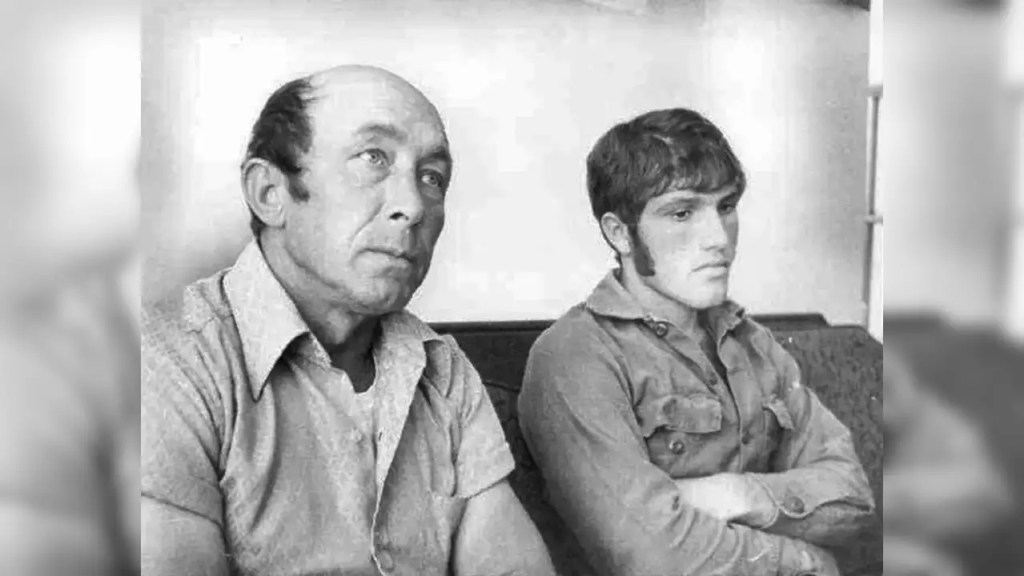
Hickson and Parker in 1973 shortly after the abduction.
Make a one-time donation
Make a monthly donation
Make a yearly donation
Choose an amount
Or enter a custom amount
Your contribution is appreciated.
Your contribution is appreciated.
Your contribution is appreciated.
DonateDonate monthlyDonate yearly Jeffery W. McKelroy
Leave a comment