by Jeffery W. McKelroy
Located on a high bluff on the east bank of the Mississippi River across from Louisiana, the historic city of Vicksburg, Mississippi was originally settled by French colonists in 1719. Throughout its storied history the one-time French outpost has survived hostile attacks by the Natchez Indians, war, riots, floods and even an epidemic that struck the area when it was a stopping point along the Trail of Tears.
French colonists and fur traders built Fort Saint Pierre in 1719. The French usually enjoyed friendly relations with most tribes that they came into contact with and in the beginning, they had a good rapport with the local Natchez tribe. The Natchez were a powerful mound building culture that dominated the area and the French operated in the region at their pleasure. In the early days of their relationship it was a symbiotic coexistence. The Native Americans allowed the French to establish plantations and trap on their land and they traded goods and services and offered each other military support. The Natchez spoke a language not related to the Muskogean languages of the other major tribes in the area such as the Choctaw. Before the Natchez, other indigenous cultures had occupied this strategic area for thousands of years but by the time of the French arrival they were the dominating military and political entity.
On November 28, 1729, after a decade of peace with the Natchez and French living alongside each other, mostly conducting peaceful trade and occasionally intermarrying, Natchez leaders were provoked to revolt when the French colonial commandant, Sieur de Chépart, demanded land from a Natchez village for his own plantation near Fort Rosalie to the south in present day Natchez, Mississippi. The Natchez plotted their attack over several days and managed to conceal their plans. Colonists who overheard and warned Chépart of an attack were considered untruthful and were punished. In a coordinated, well-planned attack on the fort and plantations, the Natchez killed almost all of the male colonists, while sparing most of the women and enslaved Africans, which they then enslaved. Approximately 230 colonists were killed overall, and the fort and homes were burned to the ground. Not even the Jesuit missionary was spared.
When word of the massacre reached New Orleans, the French mounted a counter attack with the help of the traditional enemy of the Natchez, the Choctaw. The French and Choctaw forces decimated not only the Natchez but also all their allies. The Chaouacha people were wiped out entirely. Every man, woman and child were killed in the attack on their village. The grand village of the Natchez was completely destroyed, and the few hundred survivors of the attack were sold into slavery. Many of those sold as slaves eventually escaped and folded into the Chickasaw, Cherokee and Creek tribes. The Choctaw then, by right of conquest, came to rule the area until their forced removal by the United States in 1830.
With the French no longer in the area the Spanish established Fort Nogales in 1790 but in 1798 the Americans took possession of it as part of western expansion following the revolutionary war. The Americans renamed the new settlement Walnut Hills (nogales means ‘walnut trees”) and then in 1825 the village was incorporated and named after the Methodist minister who established a mission there, Newitt Vick.
John Andrews Murrell, known as the “Great Western Land Pirate”, was a 19th-century bandit and criminal operating along the Natchez Trace and Mississippi River. On Christmas Day, 1835, Murrell and his “Mystic Clan” planned to incite an uprising in every slaveholding state by invoking the Haitian Revolution, the most successful slave rebellion in history. Murrell believed that a slave rebellion would enable him to take over the South and make New Orleans the center of operations of his criminal empire. As a result, the citizens of Vicksburg who had become tired of the lawlessness in the area organized a vigilante mob. The mob marched into town and captured and hung 5 gamblers who had been involved in the shooting death of a well-respected local doctor. Murrell was never caught by the mob and was later arrested and imprisoned in Tennessee for “slave stealing”.
During the American Civil War, the Confederate city fell after a 47day siege, after which the Union Army gained control of the entire Mississippi River. The siege was intended to starve the city into submission. Its location atop a high bluff overlooking the Mississippi River proved otherwise impregnable to assault by federal troops. The surrender of Vicksburg by Confederate General John C. Pemberton on July 4, 1863, together with the defeat of General Robert E. Lee at Gettysburg the day before, has historically marked the turning point of the Civil War in the Union’s favor. There were over 37,000 casualties during the siege with the majority, more than 32,000, being Confederate. The civilian population was reduced to eating their pets and when they were gone, the rats, and after the rats they ate their belts and boots.
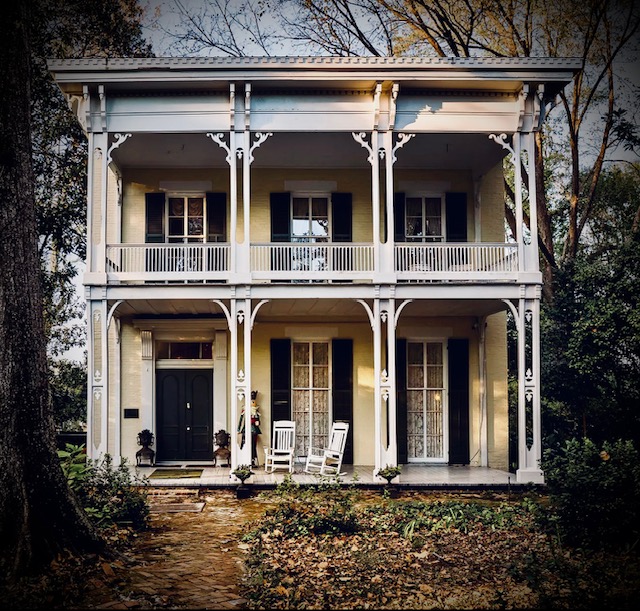
The McRaven House in Vicksburg is listed as one of Mississippi’s top 10 most haunted houses. Haunted history aside, the regular history of the home is quite interesting and tragic. The home was built in stages throughout it’s early life and became a sort of time capsule due to two spinster sisters who lived out there lives there, never changing or updating anything. The first portion of the home was built in 1797 by Andrew Glass. Local folklore claims that Glass was a notorious highway man associated with the Murell Gang and that he was murdered by a jealous wife at the home. This story has been told and retold in books, newspapers, and internet articles for decades but there is no proof that Andrew Glass was associated with the gang. There are records that show that Glass and his brother were businessmen that made a good trade selling dry goods and supplies to travelers along the Natchez Trace. The original portion of the house served as a way station for travelers on their way to Tennessee. The original structure only consisted of a kitchen on the bottom floor and a living space above it. In truth, Andrew Glass was well respected and became a wealthy man. He was so wealthy that he was the first person in the settlement to be required to pay a “luxury tax”.
In 1836 Sheriff Stephen Howard purchased the property and added the middle dining room and the bedroom above it, built in the Empire architectural style. Sheriff Howard’s wife Mary Elizabeth Howard died during childbirth in late August 1836 in the middle bedroom. Howard never recovered from the tragic loss, and he sold the house to John H. Bobb in 1849, Bobb built out the rest of the house in the Greek Revival style.
During the Civil War’s 1863 Siege of Vicksburg, McRaven was used as a Confederate field hospital and camp site as it was located along the railroad, which was continually under attack, the house was battered by cannon blasts from both the Union and Confederate forces. Confederate trenches are still visible at the back of the home. The siege of Vicksburg ended on July 4th, 1863, and the Union occupation began. On the 18th of May 1864 Union troops were camped along the railroad tracks on John Bobb’s property. A detail just relieved from picket duty decided to cut through the front yard of Bobb’s home on their way back to their regiment. They were members of the U.S. Colored Infantry and Bobb took exception to this. He walked out onto his porch and yelled at the men to get off his land and away from his house. At that Sgt. William Anderson of the USCI issued a few expletives in the direction of John Bobb. Bobb was a wealthy man and very successful. He was not accustomed to being spoken to in that manner. He dismounted the porch and picked up a brick from the yard. Sgt. Anderson was his target and his aim was true. He tossed the brick and fractured the soldier’s skull. Anderson leveled his rifle but was pulled back by his fellow soldiers. Once back at the regiment the off-duty soldiers began to drink. The more they drank, the angrier they got. Sgt Anderson just couldn’t let the incident go. He and a handful of other drunken soldiers, angry about the incident, the war and the former slave owner who attacked them picked up their weapons and made their way back to the Bobb house. Once there they called for Bobb to come out. He did and was immediately shot in the head and gut. He died there in front of his home with his family inside. Sgt. Anderson was subsequently brought up on charges of murdering a civilian non-combatant but the Court Martial found him not guilty even though he clearly was. In August of the same year Sgt. Anderson met his end at Milliken’s Bend and is buried at the Vicksburg National Cemetery under one of the many “Unknown” headstones. Selina Bobb, his wife, sold the home to a realtor in 1869 and relocated with her young son to her family’s plantation in Sunnyside, Louisiana.
Death, it seems has always been a part of the history of the McRaven home. In 1882 William Murray and his wife Ellen purchased the home and raised 4 daughters and 3 sons there. William died there in 1911, his wife ten years later. His daughter Ida died in the home in 1946, and her brother died there in 1950.
William’s daughters Annie and Ella, neither of which ever married, lived alone in the home for the rest of their lives. They enjoyed no modern conveniences except for a telephone and received no visitors except for their doctor. They lived without running water or electricity. They shunned the outside world, content to consort only with the spirits of the home as it fell into disrepair all around them. As they aged and were no longer able to forage for firewood, they began to burn the antique furniture for heat and to cook with. They shared a bed in an upstairs room. When a limb from a magnolia tree began to grow against their bedroom window, they opened it to allow the limb to grow into the room without breaking the glass. The house, sitting at the end of a dead-end street, was so overgrown that the neighbors had no idea it was there. In 1960 Ella Murray passed away at the age of 81. Following her death Annie sold the home and moved to a nursing home.
The new owner of the home completed a cosmetic restoration and opened the house for tours in 1961. The house underwent two more full restorations in 1979 and in 1984. Today the home is still open for tours. The history of the home and the unique architecture draws visitors from all over the world, but most people aren’t just making the pilgrimage for the architecture. It’s the spirits that are said to inhabit the home that draw the curious to it. With all the death and tragedy associated with the home, how could it not be haunted?
The many ghosts in the old house seem to like to make their presence known. In 1985 Leyland French of French’s Mustard owned the home. At the time that I met him he was living in what had once been the kitchen of the home with an entrance on the side of the building. He refused to go into the main home and after selling it refused to entertain any questions about it. For him, the ghostly encounters were sinister and occasionally violent. The spectral torment began one evening while he was sitting alone in his study. He was quietly reading with no TV or radio on. He began to hear footsteps in the hall and so he lowered his book. It was then that he saw the apparition of William Murray standing in the doorway. The two looked at each other as the vision slowly faded away. Soon after, mysterious knocking and scratching began. It was almost impossible to sleep. He would often hear a loud “thud” on the front porch but upon inspection would find nothing that could have caused the sound. On one occasion he was lying in bed when he began to hear a sound like feet shuffling along the floor in his room. He got up to turn on a light and have a look. Once out of bed he felt something, or someone grab the back of his head and shove him into the floor so violently that his glasses were broken, and stitches were required to close a laceration on his forehead. He would frequently see the spirits of the two spinster sisters standing at the top of the stairs, just looking down at him. His final encounter occurred just before he made the decision to sell the home. It was late evening and the yard shaded by trees and heavy vegetation was quite dark. As he stood on the front porch watching lightning bugs, he heard a faint call coming from somewhere in the darkness, “Help me. Please…….Help me.”
Leyland squinted his eyes but could see nothing. He stood still and listened, “I said help me Leyland!”, the voice called in a much louder and aggressive tone.
He could not tell if it was the voice of a man or woman because it was so raspy, but he had no desire to investigate further. That was the final straw.
The current owners of the home continue to care for it and still offer tours. Although it is a popular tourist destination, the activity of the living has not slowed down the activity of the dead. The spinster sisters are still seen wandering around the home. Voices can be heard coming from the area near the railroad tracks where the soldiers would camp during the war. Mr. Bobb is often seen sitting on the porch in the evenings. The sounds of phantom battles rattle the windows from time to time and it is not unusual to hear voices coming from empty rooms.
Somehow the McRaven home seems to exist in many different periods of time all at once and the spirits of those who lived and died there seem to have no interest in moving on. I have been to Vicksburg many times and to the McRaven house many times. I don’t know what it is that draws me back there. It is a feeling I can’t describe. When you stand alone in the living room of the home, the feeling is almost as if all the clocks have stopped, it is permanently late in the evening, and someone is coming home soon. That is as close as I can get to describing it. You’ll have to see for yourself.
Make a one-time donation
Make a monthly donation
Make a yearly donation
Choose an amount
Or enter a custom amount
Your contribution is appreciated.
Your contribution is appreciated.
Your contribution is appreciated.
DonateDonate monthlyDonate yearly Jeffery W. McKelroy
Leave a comment