by Jeffery W.McKelroy
Old Cahawba, located at the confluence of the Cahaba and Alabama rivers, was established in 1819 as the first permanent capital of Alabama. The town thrived as a political and economic center in the early 19th century, attracting settlers, merchants, and politicians. However, frequent flooding and outbreaks of disease led to its decline, and by 1826 the capital was moved to Tuscaloosa. Over the following decades, Cahawba became a bustling river town and a center of cotton distribution, but after the Civil War, the population dwindled, and the town was eventually abandoned. Today, Old Cahawba is a historic site and archaeological park, offering visitors a glimpse into Alabama’s early statehood and the shifting fortunes of its first capital.
Before it was Cahawba the town site was the location of a very large, very well organized and very old prehistoric Native American city. Between about AD 1050–1540, a Mississippian‐period Indian village stood at the confluence of the Alabama and Cahaba rivers. Key features included a flat‑topped mound of about ½ acre, a semicircular palisade wall, and a surrounding moat. When Paleoindians first reached the fertile, self-renewing landscape of Cahawba, the floodplain forest provided an abundance of natural resources necessary to support large populations. At the time of the Mississippian Stage, as the climate warmed intensive agriculture, large sedentary towns and large-scale monument building defined the era.
It is no coincidence that the end of Mississippian culture shares the date that Hernando De Soto, the Spanish explorer and conquistador marched through Alabama and the Southeast. Within 200 years of European contact with native populations, possibly more than 50% of the southeastern Indian population had perished from measles, smallpox and other diseases contracted from the Europeans. With so many deaths, entire tribes began to collapse. By the mid-1700s, most tribes in the area died out or folded into four larger nations. These nations were the Creek, Choctaw, Chickasaw, and Cherokee. There is also strong evidence pointing to this Indian city as the location of the Battle of Mabila.
In the year 1540 De Soto and his expedition followed the Alabama River to the town of Mabila where the Spaniard expected to find supplies and perhaps even information on where he could find gold. What he got was the bloodiest battle on American soil until the Civil War battle of Shiloh 332 years later. Garciaso de la Vega’s La Florida, the most detailed record of De Soto’s journey, claims “the number of Indians, men and women, who perished in this conflict by the sword and by fire was thought to exceed eleven thousand persons.” This may exaggerate the numbers, but the battle was a slaughter: eighty-two Spaniards and possibly as many as 4,000 to 5,000 Indians died in the battle. The blood spilled in this battle alone could be the reason for the ghost stories of Old Cahawba. In fact, from the very beginning of the town’s history people were reporting paranormal activity.
One well known ghost story during Cahawba’s Civil War-era was of the arrival of the town’s first apparition, the will-o’-the-wisp known as “Pegues’ Ghost.” In 1862, on a bright moonlit night, a young couple were walking behind Colonel C. C. Pegues’ home, through the thick grove of cedars on the property, when a glowing ball of white light suddenly appeared before them. Moving from side to side a few feet above the path, the apparition moved so close that they could almost touch it, then quickly disappeared in the undergrowth only to reappear beside them moments later.
The home of Colonel Pegues, the leader of the Cahaba Rifles, Fifth Alabama Regiment, was the social center of the town during this time. The large grounds with their forest of cedars, magnolia trees, Lombardy pines, scented flowers and fountains were described as the ideal retreat for lovers desperate to escape the harsh realities of war. That the apparition first showed up in 1862 seems undeniably significant, for at the Battle of Gains Mills in Virginia on June 27 that very same year, Colonel Pegues was fatally wounded. He died two weeks later. Many of the young men in town whom he recruited for the lost cause would also perish in battle.
At the old ghost town of Cahawba, the state’s first capital, the Cahaba River spills into the muddy waters of the Alabama River, ending the run of the state’s longest, free-flowing river at the site of what was to be the greatest of Alabama cities. Along the road leading to Cahawba, Spanish moss drapes the aged oaks majestically lining the route, and a sense of the fallen grandeur on the quiet country road seems to intimate its significance. It is not reconstructed or rebuilt. It is not a theme park. It is real. A town conceived by Alabama’s first governor, William Wyatt Bibb, to “vie with the largest towns in the country” is today preserved through the founding of an archeological preserve. A town that once held the largest mansion in the state, as well as one of the finest hotels, a female academy and several prominent newspapers all but disappeared after the Civil War. There are many reasons for Cahawba’s demise, changing settlement patterns, the limitations of early travel, regional politics and mostly a healthy dose of bad luck.
When Alabama was becoming a state, its first governor, William Wyatt Bibb, planned to incorporate the old earthworks (including the mound and moat) into the town plan for the future capital. He even considered building the statehouse on the ancient mound. The circular moat surrounding the mound became Arch Street. Things progressed quickly. The Federal land office opened to sell land in Cahawba. In weeks, land in the new capital that sold for $1.25 an acre went for $60 and $70 an acre. By 1822, unimproved lots in the central part of town sold for as high as $5,025. Numerous stores, two newspapers, a theater, state bank, hotels, two ferries, and an imposing two-story brick capitol building emerged. The town was booming, and the future was looking bright, and yet disaster struck. The national economic panic of 1819 finally reached Alabama, forcing many into debt. The summers of 1821 and 1822 brought yellow fever. By 1822, heavy rainfall brought the Cahaba and Alabama Rivers up and into the town’s outer limits, and critics began calling for the capital’s removal. On December 13, 1825, by one single vote, the capital was moved to Tuscaloosa. Cahawba’s capital days were over.
Almost overnight the population dropped to as low as 300. The former capital building was surrounded by abandoned log cabins and a few brick structures. Many of the more influential residents moved on, selling or bringing their houses with them to towns like Mobile, Selma, and Tuscaloosa. It is difficult to imagine these early settlers’ experiences, moving into a region that was until very recently Choctaw or Creek territory, carving a capital from the wilderness and then simply departing.
Although the capital and all the prestige that comes with it were gone, boom times would return and bring many new settlers to Cahawba. With steamboat navigation continually improving, a steady influx of people, and the growth of the cotton industry, Cahawba could not help but grow.
By the mid 1800’s the cotton business was booming and this meant big business for Cahawba. Cotton was grown in the fertile soil in the northern part of the state and then sent to Cahawba to ship via the Alabama river down to Mobile.
In May of 1856 Cahawba’s economy was experiencing seemingly unstoppable growth. The rest of the nation was, however, in turmoil. Senator Charles Sumner of Massachusetts was brutally caned by Representative Preston Brooks which further deepened the growing political divide in the country. Bleeding Kansas and Harper’s Ferry became prelude to the coming Civil War, but Cahawba had it’s own civil war brewing and it would begin and end on May 30th ,1856.
Friday brought an end to another long week and as the sun was beginning to set on Vine Street between First North St. and Second St. trouble was brewing. A bloody fight to the death between prominent citizens of the former capitol was about to take place right in the center of town. There had been several fires set in town and the authorities believed they were all the work of the same arsonist. The chief suspect was a slave by the name of Pleas who was owned by John Bell. John Bell was rumored to be sending Pleas on night missions to burn down the homes and businesses of his rivals. Accusations were made against the slave, but the Bell family vehemently defended him. Then the homes of Dr. Troy and Judge Bird were set ablaze. Judge Bird had reached his limit. He openly accused Pleas of the crime of arson and claimed the Bells were accessory. The Bells were incensed at the accusations and would not let go the public attacks on their honor. Dr. Troy also openly accused the Bells by filing a lawsuit for damages in a civil court. So, on that Friday afternoon, after being served with the lawsuit, John Bell marched down Vine Street with a hickory stick in one hand and a pistol in the other. Dr. Troy was quietly reading his newspaper on his front porch and did not see his assailant coming. With no warning John Bell began beating him with the hickory stick. The doctor was caught unaware and had no time to react. It was certainly not a fair fight. This assault was in the middle of town with light still in the sky and so the witnesses were numerous. One of those witnesses was John Bell’s brother Charles who saw the fight and decided to join in. He ran towards the fight and started firing his pistol at the Doctor. Having heard the commotion, the Doctor’s two brothers-in-law, Judge Bird and Dr. Hunter, ran toward the melee. As they arrived so too did Colonel John R. Bell, the father of John and Charles, wielding a shotgun. Seeing the elder Bell level the shotgun Judge Bird and Dr. Hunter then pulled their pistols. All took aim and began firing with intent. Colonel John R. Bell and his son, and namesake, were both shot in the head and died instantly at the scene. Charles fled the gunfight unharmed. It was miraculous that Judge Bird, Dr. Troy and Dr. Hunter all escaped unscathed. Although shortly after Judge Bird and Dr. Hunter were arrested as well as Charles Bell. Once the investigation was completed all three were released and that was the end of it, with the exception of the inscription on the head stone of young John Bell, “No murderer hath eternal life abiding in him.”
It is no surprise to those with an interest in the paranormal that violent actions such as these seem to be the main ingredient in the making of a haunting, and it seems as though Vine Street is haunted. The house where Dr. Troy was attacked and all those around it are gone but the street is still there, and some say so are the spirits of two men cut down in a gun fight. Daryl Jackson worked as a groundskeeper for the archeological park for 10 years. There were many times when he felt like he was being watched or he thought he might have heard footsteps, but he wasn’t sure. All together he never really had what he would call a paranormal experience. If anything strange happened he could always reason it away. His last day of work was a cold day in mid-December. It was late in the afternoon, and it was cloudy and dark. He was drinking coffee more for the warmth than anything, but no matter the reason the outcome is always the same. He had to relieve himself. He stopped his truck on Vine Street, got out with it still running and walked to the back to take care of business. Just as he was unzipping his pants, he heard the rustling of clothing, he then felt as though someone had put their forearm across his back and pushed so hard he nearly fell over. He heard a gravely voice say, “Not you!”
“I was confused because not only did it happen so fast, but it felt and sounded like a person, but when I turned around there wasn’t anybody there.”, said Daryl, “I have no idea why it said what it said but that was what I heard. I packed it in and went back to the Welcome Center. I couldn’t sleep all night. The next day I called the paper mill to see if they were still hiring and I wrapped up my time at Old Cahawba. I’ve always said I don’t believe in ghosts, and I don’t. I do believe in the devil though and that’s something I want no part of.”
Other witnesses have said that they have seen the specter of a Confederate Officer on horseback throughout the old ghost town and some speculate that it could be the Colonel. Maybe, but there were a lot of Confederates around the old capitol during the time of the war. Perhaps there are more ghost soldiers patrolling the old city than just the Colonel.
In 1858 the Marion to Cahawba line of the railroad was completed. The town had been waiting for this moment as it would bring more prosperity and ensure the permanent survival of the town. However, the victory was short lived. Almost as soon as the last track was laid the Confederate Army tore up the tracks to complete the Selma-Demopolis Line for the war effort.
In 1863 the Cahaba Prison was opened. It was a Confederate prison camp for Union P.O.Ws during the Civil War, where it held approximately 5,000 Union prisoners. Conditions were poor, but its survival rate was better than other Confederate camps like Andersonville. After the war, the released Union prisoners were sent to Vicksburg, Mississippi, and boarded the steamship Sultana, which later exploded, causing a major maritime disaster with many casualties. The Sultana disaster caused the deaths of approximately 1,800 people, making it the deadliest maritime disaster in U.S. history. Most of the casualties were recently paroled Union soldiers returning home from Confederate prisoner of war camps. The tragedy occurred on April 27, 1865, when the steamboat, severely overcrowded with over 2,100 people, exploded on the Mississippi River near Memphis, Tennessee.
Today, near the site of the old prison camp visitors to the ghost town tell of seeing dark figures in the woods looking back at them from behind trees. Sometimes the shadow figures are simply walking through thick, overgrown forest, seen for just a moment, and then they disappear. Some say they are the souls lost on the Sultana, confused they have returned. Others say they are spirits of the Indians that once owned the land.
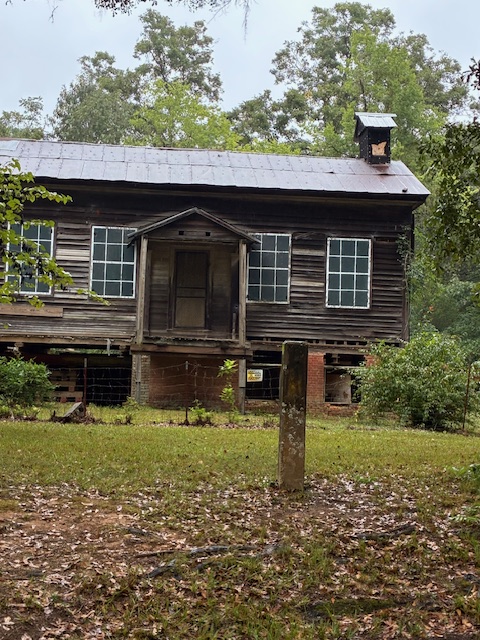
After the Civil War many of the freed slaves remained in Cahawba. By 1860, 64% of Cahawba’s population was African American. In Dallas County, three out of four people were black. After emancipation many citizens played prominent roles fighting for hard-won political freedom. Many became landowners. When the county seat was removed to Selma in 1866, Cahawba’s prominence was at the end. By 1870, the number of blacks dwindled to 302 while the overall population stood at 431. By this time, Cahawba became known as the “Mecca of the Radical Republican Party,” a derogatory nickname given by Selma residents since the deserted, half-destroyed courthouse became a rallying point for freedmen attempting to solidify the moderate political gains they had secured during Reconstruction. As the years passed, the town of Cahawba dwindled further. The local black community built a school themselves from salvaged materials for local children. It sat adjacent to St. Paul’s African American Methodist Episcopal Church, which had earlier served as a temporary schoolhouse. Today, the school is one of only three structures still standing at the Old Cahawba site.
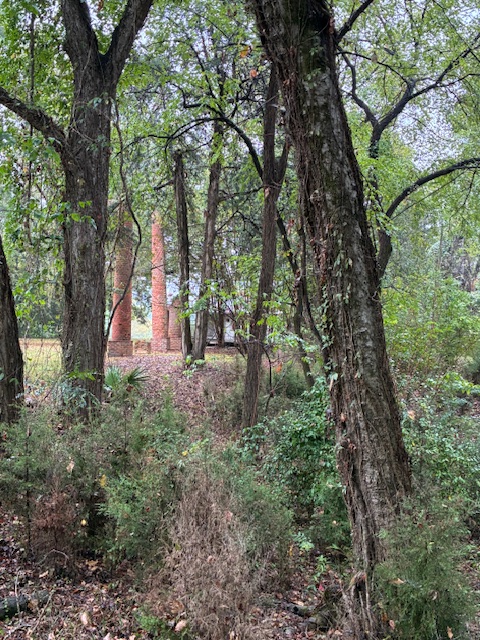
The town was finally unincorporated in 1989 though it had ceased to function as a town many years before. Today the old state capital is an archeological site, a tourist attraction, and living history. Several of the streets are still drivable, and there is a welcome center with historical information. There are abandoned homes still standing, ghostly columns still rise high where the rest of the home has since faded away and the sunken basements and cellars are still visible. You can still see street signs in the woods overgrown with vines and weeds. Standing on the street in front of where the capitol building once stood, in the eerie silence it is hard to imagine how busy it must have been in that spot when the sidewalks were bustling with people living their lives while horses and buggies ambled down the dusty streets. Now it is all just a memory as what is left of the town is slowly swallowed by nature. So many gave their lives to carve out a home here, to defend what they had built and to have a chance in a harsh world that only favored the strong and the brave. Maybe some of those souls have invested too much in this land to leave it. In the Choctaw origin story, it is told, that the people sprang from the land, this land, this place. Do their spirits return? Are the will o’ the wisps seen floating through the trees the spirits of the original inhabitants? Is the ghost of Colonel Bell stuck in time? Maybe he is forever trying to push his son to safety just as they both meet their end only to repeat the moment again for eternity. Only those who have seen or heard or felt the other worldly forces at work in Old Cahawba know for sure.
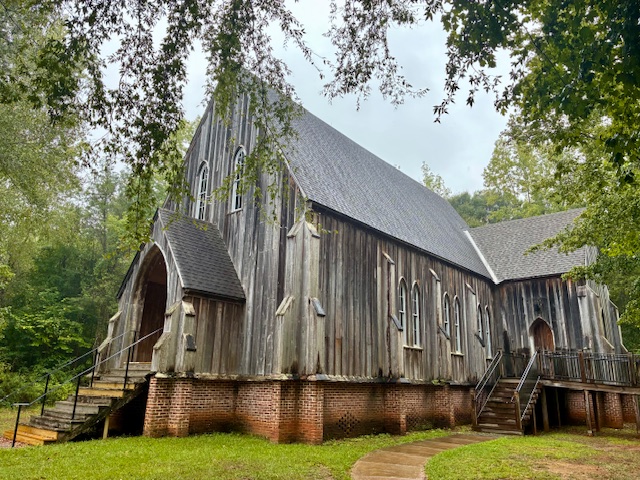
The old church

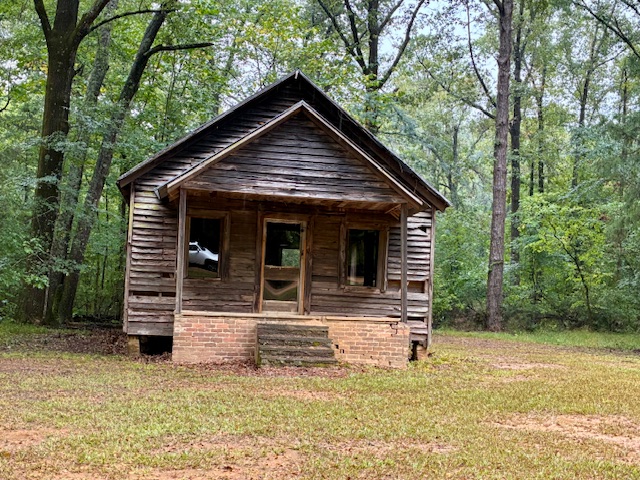

This house overlooking the river was wired for electricity

The columns are the last remnant of a stately home
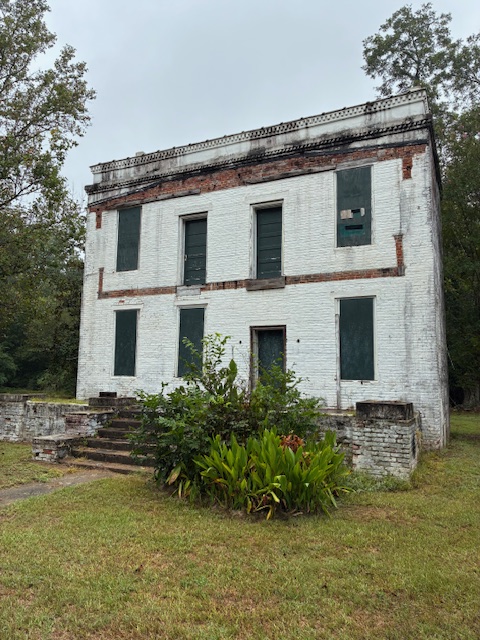
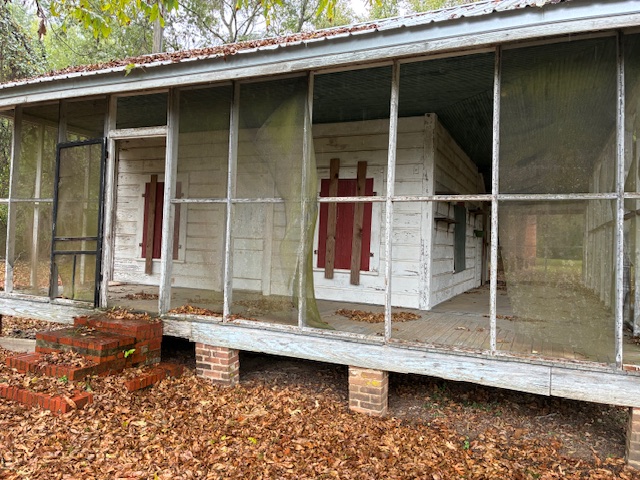
Former slave quarters turned into the primary residence, now abandoned
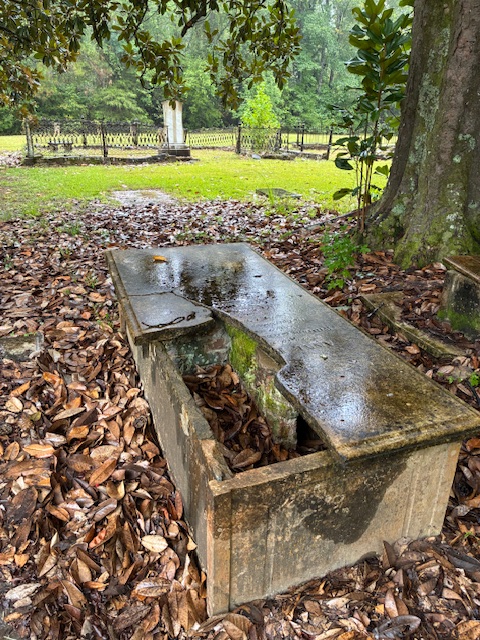
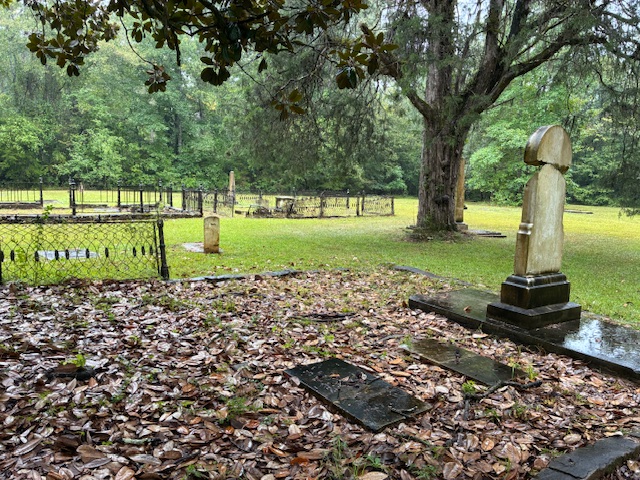
In the 1960’s vandals struck the cemetery
Make a one-time donation
Make a monthly donation
Make a yearly donation
Choose an amount
Or enter a custom amount
Your contribution is appreciated.
Your contribution is appreciated.
Your contribution is appreciated.
DonateDonate monthlyDonate yearly Jeffery W. McKelroy
Leave a comment